
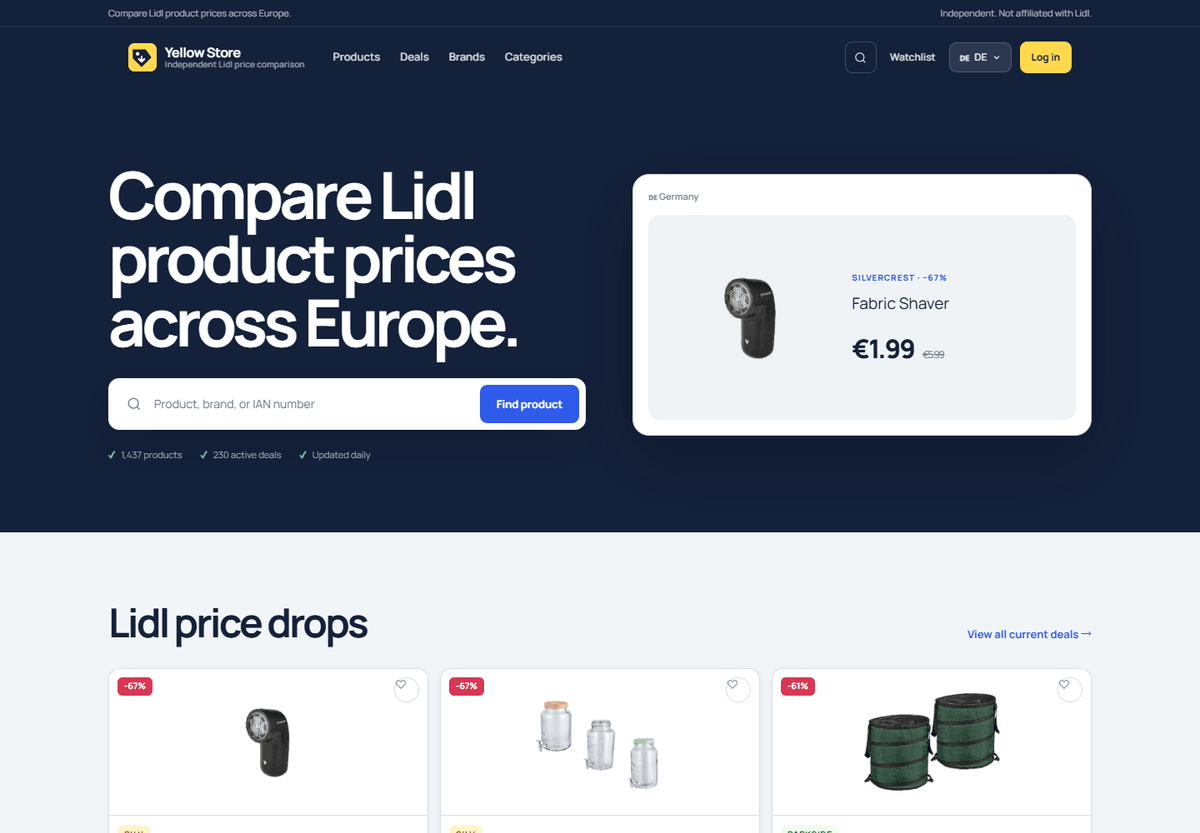
Fan websites are often imagined as places for news, photos, and discussion. Yellowshop.fans takes a more utilitarian route. It is an independent website that organizes Lidl product information and deals across several European markets, giving bargain hunters a searchable destination for comparing what is listed in different countries.
The site prominently says it is independent and not affiliated with Lidl. That disclosure is essential because the subject is a well-known retailer and the pages contain product names, brand references, images, and prices. Within that boundary, Yellowshop demonstrates how enthusiasm for a retail ecosystem can become a repeat-use information tool.
Case Snapshot
- Website: yellowshop.fans
- Category: independent retail product and deal comparison
- Primary audience: Lidl product followers and cross-border bargain hunters
- Markets shown: Germany, Poland, Czechia, France, Belgium, Spain, Slovakia, and the Netherlands
- Observed features: product search, deal listings, categories, brand catalogs, country controls, filters, and watchlist access
- Website checked: September 8, 2026
A Utility Built Around Recurring Questions
The homepage answers the questions that bring product enthusiasts back: What is available? Where is it listed? Is there a deal? Which brand or category does it belong to? Instead of asking visitors to follow a general stream of updates, the interface lets them search and narrow the catalog.
That distinction matters. A useful fan destination can be built around a repeated task rather than a content calendar. When information changes frequently, the service becomes valuable by reducing the effort needed to scan several markets or store promotions. The site's country selector makes this cross-border purpose visible from the start.
Products, Deals, Brands, and Categories Work Together
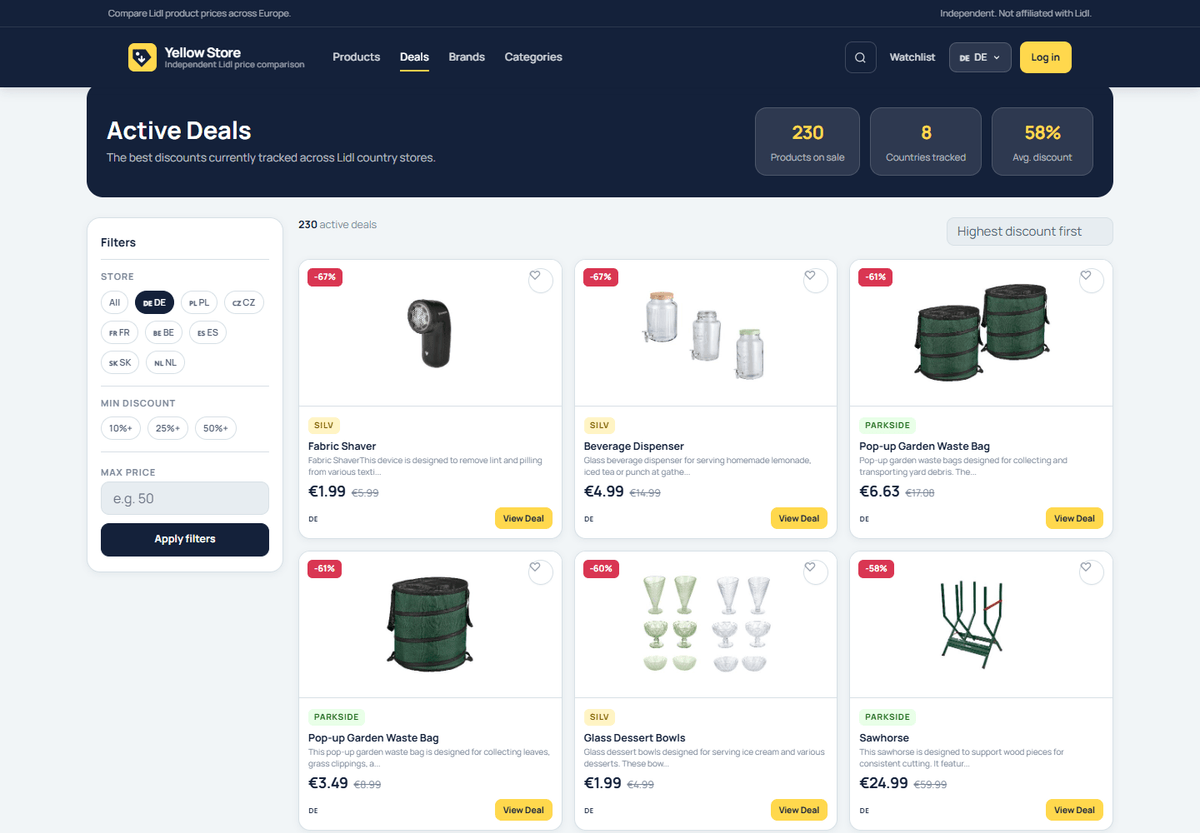
Yellowshop separates discovery into several routes. Product pages organize individual items. The deals area adds filters for store, discount, and price. Brand pages group related products, while categories help visitors explore without knowing an exact name.
The Parkside catalog is a good example of that structure. Someone interested in the brand can move through tools and related products without searching the entire database. Country indicators make geographic differences visible, and deal labels create another layer of comparison. The design turns a broad retailer catalog into smaller, intent-based paths.
Search, filters, and pagination are ordinary interface components, but together they are the core editorial system. Every field must be normalized consistently for those controls to remain trustworthy. Product names, currencies, pack sizes, dates, stores, countries, and discount calculations all need clear definitions behind the screen.
Dynamic Numbers Need Context
During the September 8 review, the homepage displayed totals for products and active deals and described the data as updated daily. Those figures are a snapshot of a changing service, not permanent facts about its inventory. A case article should therefore focus on the workflow rather than freeze a temporary count into a long-lived promise.
The same applies to every listed price. Promotions can expire, availability can vary by store, taxes and currencies differ, and product descriptions can change. A comparison site should show update times and source boundaries, while shoppers should confirm the final price and availability with the retailer before making a trip or purchase.
Why the .fans Domain Fits a Shopping Utility
The `.fans` ending signals that Yellowshop is made for people who actively follow a product universe. This is broader than corporate fandom. Some audiences gather around recurring product drops, tool ranges, collectibles, seasonal offers, or the practical skill of finding a good deal.
“Yellowshop” hints at the retailer's recognizable color world, while `.fans` frames the website as an enthusiast resource. Because the site clearly states that it is independent, the domain can help express community purpose without claiming corporate ownership. That separation should remain visible on search results, social previews, about pages, and any page where a visitor might otherwise assume affiliation.
Execution Lessons for Independent Fan Utilities
- Build around a recurring job. Search, compare, filter, save, and verify are stronger return reasons than a generic news feed.
- Make geography part of the data model. Country and currency differences should be explicit, not buried in product descriptions.
- Create several discovery routes. Products, deals, brands, and categories support different visitor intentions.
- Time-stamp changing information. Deal status and last-updated details help visitors judge whether a listing may still be useful.
- State independence prominently. Trademark and affiliation boundaries should be clear wherever the third-party brand is central.
Rights, Accuracy, and Consumer Boundaries
An independent catalog carries responsibilities that a simple fan blog may not. Product images, descriptions, logos, and trademarks can be protected. Operators need a lawful basis for the materials they publish, a process for correction and removal requests, and careful wording that avoids impersonating the retailer or manufacturer.
Price accuracy is another trust issue. The site can summarize and compare public information, but it should avoid implying guaranteed stock or checkout prices. Affiliate relationships, sponsored placement, or commercial incentives should be disclosed if introduced. Account and watchlist features also create privacy and security obligations that do not exist on a purely anonymous catalog.
Practical Takeaways
A niche comparison project should begin with a strict schema: product identity, brand, category, market, retailer, currency, current price, previous price, promotion period, source, and update timestamp. Next, design views around the user's most common decisions. Only then should the team add alerts, watchlists, or accounts.
A focused address can make that tool easier to remember. The .fans use cases show how the extension can support many types of audience destination, while the .fans identity overview explains its audience-first positioning. Name availability can be checked on the registration page.
Conclusion
Yellowshop.fans shows that a fan-oriented domain does not have to lead to a conventional fan club. It can support a practical service for people who repeatedly follow products and promotions. The site's strongest idea is structural: organize changing retail information by the decisions visitors actually make. Its independence notice, geographic controls, and multiple discovery paths are as important as the catalog itself. For similar projects, usefulness earns the return visit, while transparency protects the relationship.