
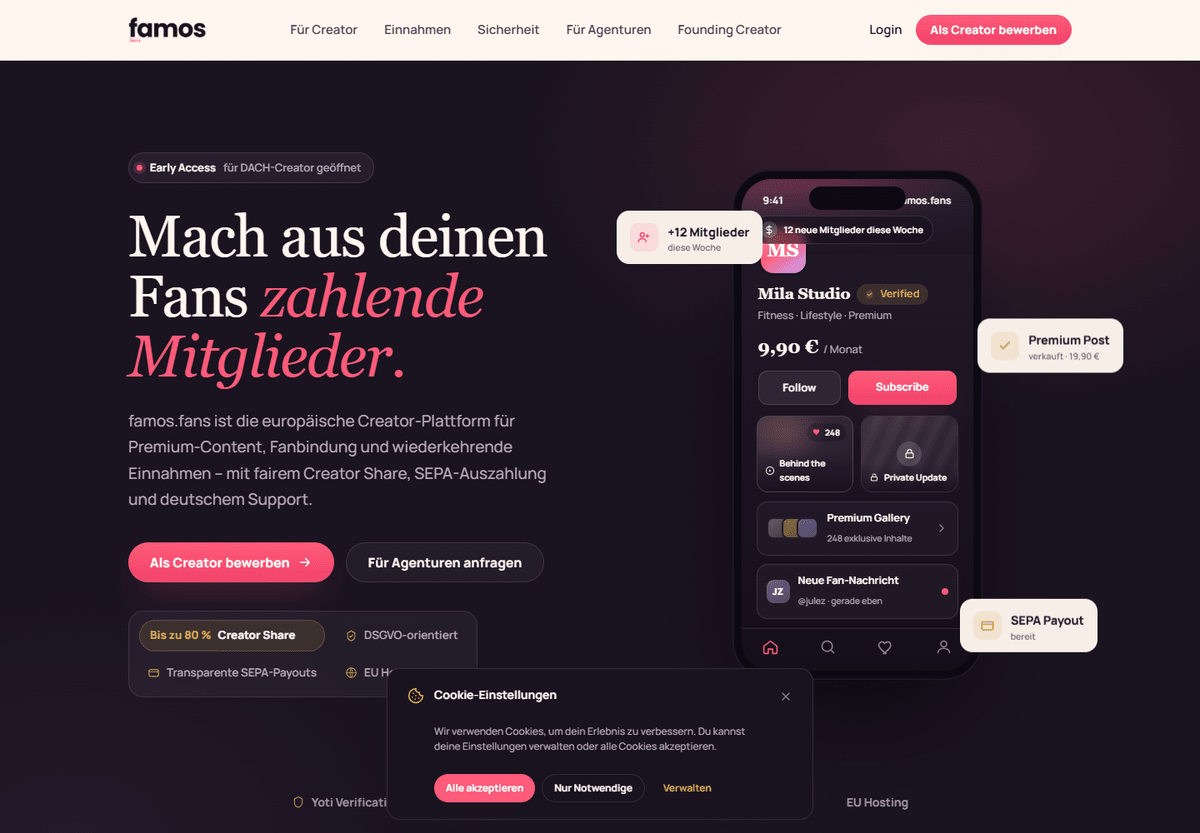
A creator platform does not become locally relevant merely by translating its buttons. It must explain payments, moderation, support, privacy, and business operations in terms that make sense to the people it expects to serve. Famos.fans offers a useful example. The German-language website presents an early-access platform for creators, fans, and agencies in Germany, Austria, and Switzerland.
The public pages connect several parts of that proposition: recurring memberships, individual paid posts, tips, referrals, agency administration, identity verification, payout information, and an unusually visible collection of policy pages. The result is not evidence of commercial success, and the website should not be read as an independent compliance audit. It is, however, a clear case of aligning a memorable fan-facing domain with a defined regional operating model.
Case Snapshot
- Website: famos.fans
- Category: creator membership and premium-content platform
- Primary audience: creators, fans, and creator agencies in the DACH region
- Observed features: memberships, paid posts, tips, referral messaging, agency tools, creator applications, and trust pages
- Public status: presented as early access during review
- Website checked: September 8, 2026
Start with a Specific Market
Famos introduces itself around the DACH market rather than addressing every creator everywhere. That choice gives the homepage a concrete vocabulary. The site refers to German-language support, euro-denominated payments, SEPA payouts, European hosting, and regional expectations around privacy and verification.
This is a useful positioning lesson. A new platform can sound more credible when its public experience reflects the operational questions of a particular audience. Creators do not only ask whether they can publish. They ask how they will be paid, who will answer support requests, what happens when content is reported, and which rules apply to their account. Local relevance is the sum of those answers.
One Product Story for Creators and Fans
The creator proposition centers on several familiar forms of direct support. Public pages describe recurring memberships, individually purchasable posts, and tips. Together, those options let a creator imagine more than one relationship with an audience: a committed member may subscribe, an occasional visitor may unlock one item, and another supporter may send a voluntary contribution.
For fans, clarity matters more than the number of monetization options. A platform should make price, renewal, cancellation, content access, refund conditions, and creator identity understandable before a purchase. Famos links to terms, refund information, acceptable-use rules, and a standard fan-creator contract. Making those documents visible does not by itself prove how every dispute will be handled, but it gives visitors a place to inspect the stated rules.
Agency Operations Are Treated as a Separate Workflow
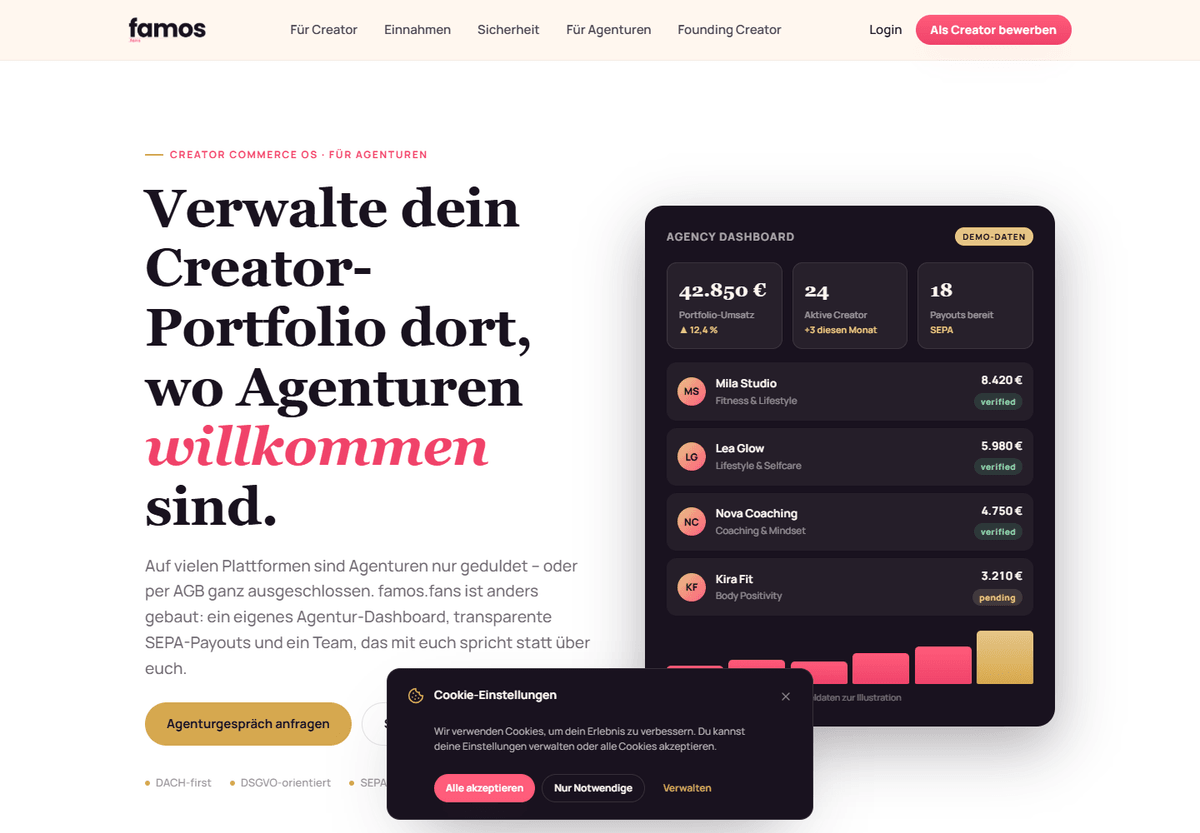
The agency page expands the case beyond a two-sided creator marketplace. It presents tools for managing several creators, viewing consolidated information, controlling roles, and handling invitations. This recognizes a practical reality: some creators work with teams that coordinate publishing, promotion, administration, or support.
The dashboard shown on that page is explicitly presented as a demonstration. Its numbers should therefore be understood as interface examples, not as verified creator counts, earnings, or platform results. That distinction is important in any case study. Product mockups can show what a workflow is designed to do without proving that customers have achieved the figures displayed inside it.
Trust Information Is Part of the Product
Famos gives substantial public space to age and identity checks, moderation, watermarking, privacy, community rules, copyright reporting, and account safety. The website describes EU hosting and a privacy-oriented approach, alongside verification and content-protection measures. These are the platform's own representations and should be evaluated through its policies and actual operations.
Still, the information architecture is instructive. Trust is not hidden in one footer link. It appears as part of the reason a creator or fan might choose the service. Platforms handling payments and restricted content carry higher expectations around age assurance, consent, reporting, data minimization, record keeping, and appeal processes. Clear policy navigation helps people identify those responsibilities before joining.
Why the .fans Domain Fits
The name combines a short brand term with a direct description of the relationship the product serves. “Famos” supplies identity; `.fans` supplies audience context. The address can work for creator profiles, agency conversations, and fan purchases without narrowing the platform to one media format.
That is the practical advantage of a fan-first domain identity: the audience is visible in the address before a visitor reads the interface. The domain cannot guarantee trust or adoption, but it can make the intended relationship easier to recognize.
Execution Lessons for Creator Platforms
- Define the first market precisely. Language, payments, support hours, policies, and creator onboarding should reinforce the same regional promise.
- Explain each transaction model. Memberships, one-time purchases, and tips need distinct terms and expectations.
- Design for teams as well as individuals. Roles, permissions, invitations, and consolidated views become important when agencies participate.
- Keep trust material close to conversion. Verification, refunds, privacy, moderation, and reporting should be easy to find before payment.
- Label demonstrations honestly. Interface examples must not be mistaken for measured business outcomes.
Boundaries to Review Before Launch
A creator platform must turn public promises into repeatable processes. Operators evaluating a similar model should review payment regulation, taxes, consumer cancellation rights, age assurance, privacy roles, prohibited content, copyright complaints, creator verification, chargebacks, record retention, and cross-border access. Legal labels such as “GDPR compliant” should be supported by documented practices and professional review, not only marketing copy.
The same caution applies to creator earnings. A list of monetization tools describes capability, not likely income. Results depend on audience demand, pricing, content quality, promotion, retention, platform fees, taxes, and many other factors outside the domain name.
Practical Takeaways
Teams planning a membership destination can begin with a simple map: who publishes, who pays, who supports the account, what each participant can do, and which rule governs each exchange. Then connect that map to the navigation. A creator page, checkout, agency dashboard, trust center, and support channel should feel like parts of one system.
For naming, review ways to use a .fans domain, consult the .fans FAQ, and check availability through the registration page. The strongest name is one that accurately frames a product whose operational details are equally clear.
Conclusion
Famos.fans shows how regional focus can shape more than homepage copy. The DACH positioning appears in payment language, support, agency workflows, verification, and policy navigation. Its central lesson is that a fan platform's public identity should describe the whole relationship, not merely the content being sold. The `.fans` ending makes the intended audience immediately legible; the surrounding product and trust information must earn the confidence that the name invites.