
Creators and brands often build years of audience relationships inside platforms they do not control. Posts, media, comments, engagement history, and account access can be affected by policy changes, suspension, security incidents, or shifting algorithms. ShellFans frames that problem as social-asset continuity.
The Taiwan-based service presents a cross-platform continuity engine, fan analysis, reputation-marketing workflows, and AEO/GEO managed hosting. Its website is a useful `.fans` case because the domain expresses the product's organizing object: the durable relationship between a creator or brand and its audience. The feature descriptions are first-party claims and should be evaluated against current plans, permissions, policies, and platform restrictions.
Case Snapshot
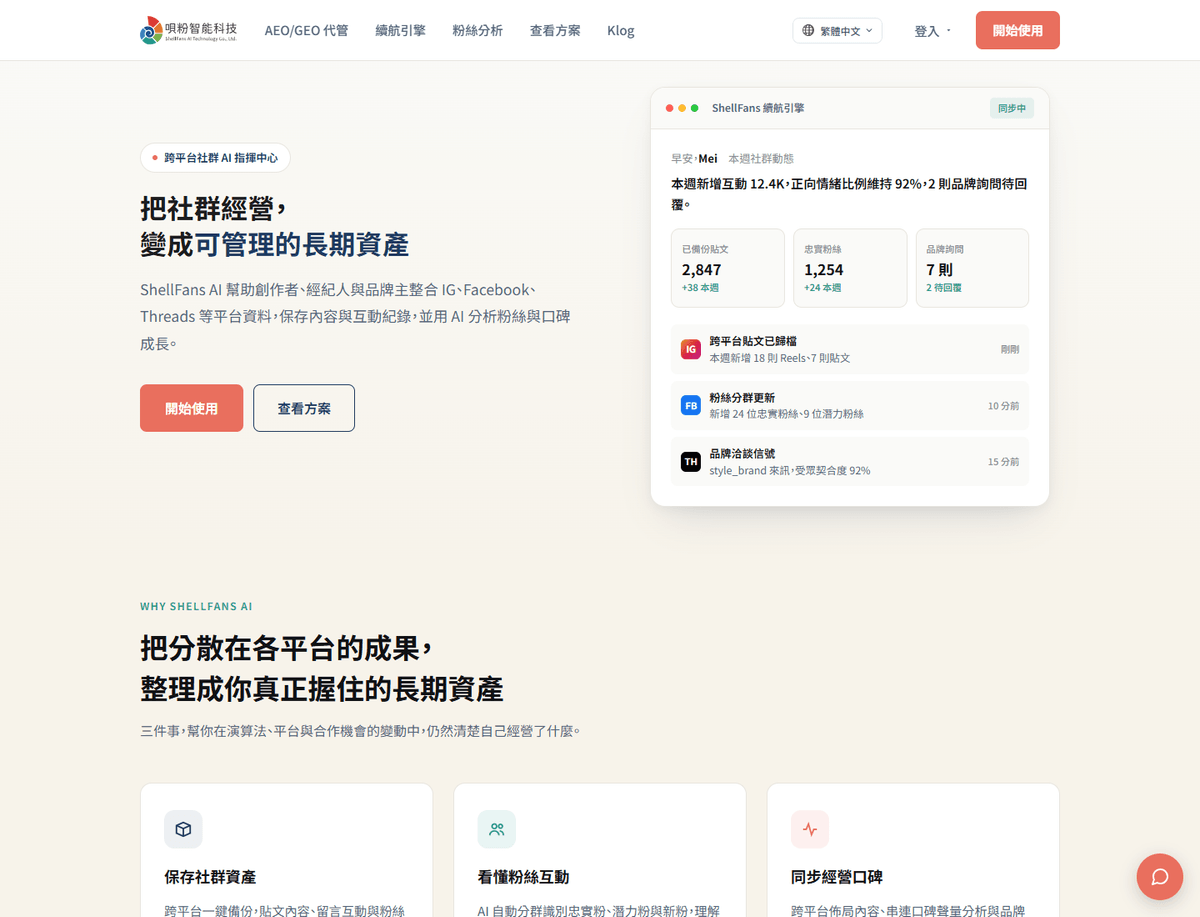
- Website: shell.fans
- Category: social-media continuity, analytics, and marketing technology
- Audience: creators, talent managers, agencies, brands, and enterprise marketing teams
- Public features: social-asset backup, fan analysis, social search chat, reputation workflows, pricing, help center, login, and AEO/GEO services
- Activity checked: September 4, 2026
The Homepage Begins with a Recognizable Risk
ShellFans positions social posts, media, comments, growth data, and audience profiles as assets that should not exist only inside one network. Its public pages describe support for Facebook, Instagram, and Threads, while marking X and TikTok support as forthcoming in several places. The distinction between available and planned integrations is important and should remain consistent across pricing, help, and onboarding.
This risk-led framing gives a technical product a clear starting point. Instead of asking visitors to understand a database or machine-learning stack, the site begins with a familiar concern: what happens to years of community work when an account or platform becomes unavailable?
Three Audience Roles Make the Product Concrete
The homepage provides separate views for creators, managers, and brands. Creators are shown content archives and fan identification; managers see multi-account dashboards and collaboration records; brands see audience matching, interaction quality, and reputation analysis. These role descriptions make the same underlying data meaningful in different daily workflows.
Role-based messaging is especially useful for products sold to teams. A creator may care about continuity, an agency about coordination, and a brand about evidence for partnership decisions. Each role still needs to see which functions are included in its plan and which depend on third-party API access.
The Continuity Engine Becomes a Step-by-Step Flow
ShellFans describes three stages: connect supported accounts through authorization, archive and analyze content and interactions, then produce reports or action suggestions. The dedicated social-media-backup page expands the categories to posts, media, public interaction records, growth data, and audience profiles.
The site also acknowledges an important boundary: complete fan identities and personal data are constrained by platform APIs, permissions, and privacy rules. That qualification improves the product explanation. No service can turn a third-party social network into unrestricted first-party ownership, and customers should understand exactly what can be exported, restored, or migrated.
The .fans Domain Holds the Product Lines Together
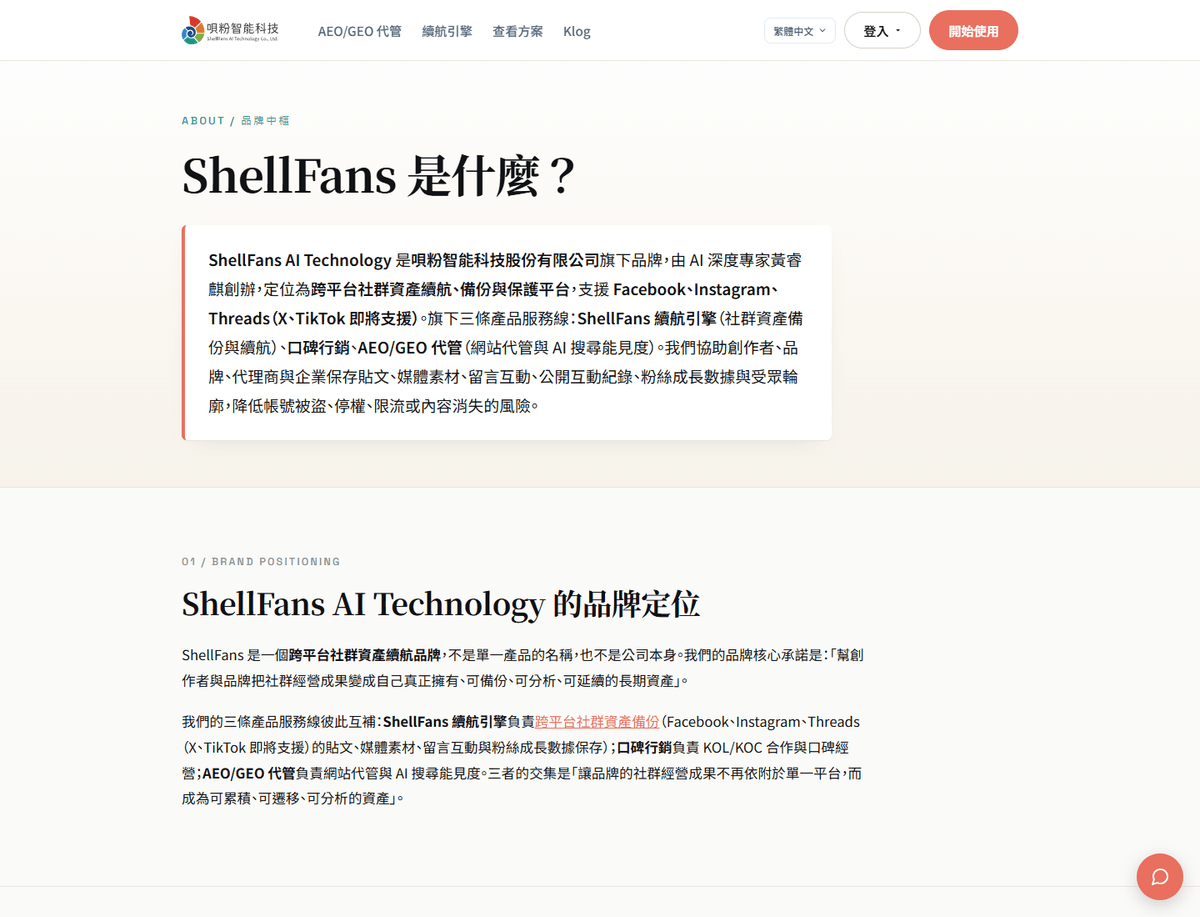
Backup, analytics, KOL workflows, reputation monitoring, and AI-search optimization could easily feel like unrelated tools. The ShellFans name gives them a shared theme: helping organizations understand and preserve the value created around fans and communities.
This is a business-to-business interpretation of the .fans domain. The customer is not necessarily a fan club; it may be a professional team responsible for audience relationships. A concise domain can still express the end beneficiary of a technical system.
Social AI Needs Visible Evidence Boundaries
The public social-analysis interface invites questions about topics, creators, and brand conversation across several platforms. The page warns that AI can make mistakes and says analysis may take time. That disclosure should be paired with source links, coverage dates, sampling limits, confidence indicators, and a clear distinction between public data and connected-account data.
Sentiment labels and creator recommendations can influence commercial decisions. They should be reviewable rather than presented as objective facts. Teams also need processes for correcting misclassification, excluding sensitive attributes, and preventing a convenient score from replacing human judgment.
Five Lessons for Audience-Technology Brands
- Lead with the operational risk. Continuity is easier to understand than a list of storage and analysis features.
- Map features to roles. Creators, managers, and brands need different explanations of the same system.
- Label planned support clearly. Roadmap integrations should never look identical to working connections.
- Define what “backup” means. Content, media, comments, metrics, identities, and restoration rights are different things.
- Make AI output inspectable. Dates, sources, limits, and correction routes support responsible decisions.
Privacy and Platform Dependence Are Core Constraints
Connecting social accounts may grant access to valuable business data and personal information. Buyers should review authorization scopes, retention, encryption, employee access, subprocessors, deletion, backup geography, breach response, and what happens when a subscription ends. They should also test whether a restored archive preserves the formats and relationships needed for future use.
Third-party platform terms and APIs can change. A continuity product should therefore publish integration status, last successful sync, gaps, export formats, and a recovery runbook. Marketing language about ownership should remain precise about the rights a customer actually receives.
Practical Takeaways for a Fan-Data Product
Define one measurable recovery scenario before expanding into broad analytics. Show customers what is captured, let them export a sample, document missing fields, and rehearse restoration. Then add analysis with traceable evidence and human review. The product page, pricing table, help center, and contract should describe the same capability set.
Teams naming an audience-focused platform can review why .fans fits community-centered brands, consult the .fans FAQ, and check availability on the registration page. Privacy, security, platform terms, and AI governance require separate diligence.
Conclusion
Shell.fans shows how a `.fans` address can support a technical B2B proposition. The site's strongest move is to frame dispersed social activity as a long-term asset, then explain that idea through creator, manager, and brand workflows. Its credibility will depend on precision: what is supported now, what data is available, what AI can infer, and what recovery actually looks like. Clear boundaries turn an appealing promise into an evaluable service.