
Specialist research is most useful when readers can recognize its scope, find older material, and understand its limits. OSINT.fans provides a compact example. The independent publication focuses on open-source intelligence, phishing, spam campaigns, online scams, and practical investigation techniques.
The newest article displayed on the homepage is dated May 2022, so this is not a case of a fast-moving daily newsroom. It is better understood as a live, maintained archive: its homepage, search, RSS feed, newsletter route, disclaimer, and article pages were all accessible when reviewed. The footer also identifies May 29, 2025 as the site's last update date. That distinction matters because a credible case study should describe what visitors can verify, not imply a publishing frequency the archive does not show.
Case Snapshot
- Website: osint.fans
- Category: independent OSINT and information-security publication
- Audience: investigators, security practitioners, researchers, and readers studying online abuse
- Public features: article archive, site search, RSS, newsletter link, About page, and disclaimer
- Activity checked: August 19, 2026
A Domain That Defines the Editorial Beat
OSINT is an established abbreviation for open-source intelligence. Pairing it with .fans produces a name that reads like a destination for people who actively follow and practice the discipline. The domain does not need a long slogan to explain the community of interest behind the publication.
That is a useful naming lesson for any narrow knowledge project. A fan community is not limited to entertainment. It can also form around a craft, method, technology, or professional field. The examples collected in real-world .fans use cases show how the extension can frame a shared subject, while OSINT.fans demonstrates the editorial version of that idea.
The Homepage Works as an Index, Not a Sales Page
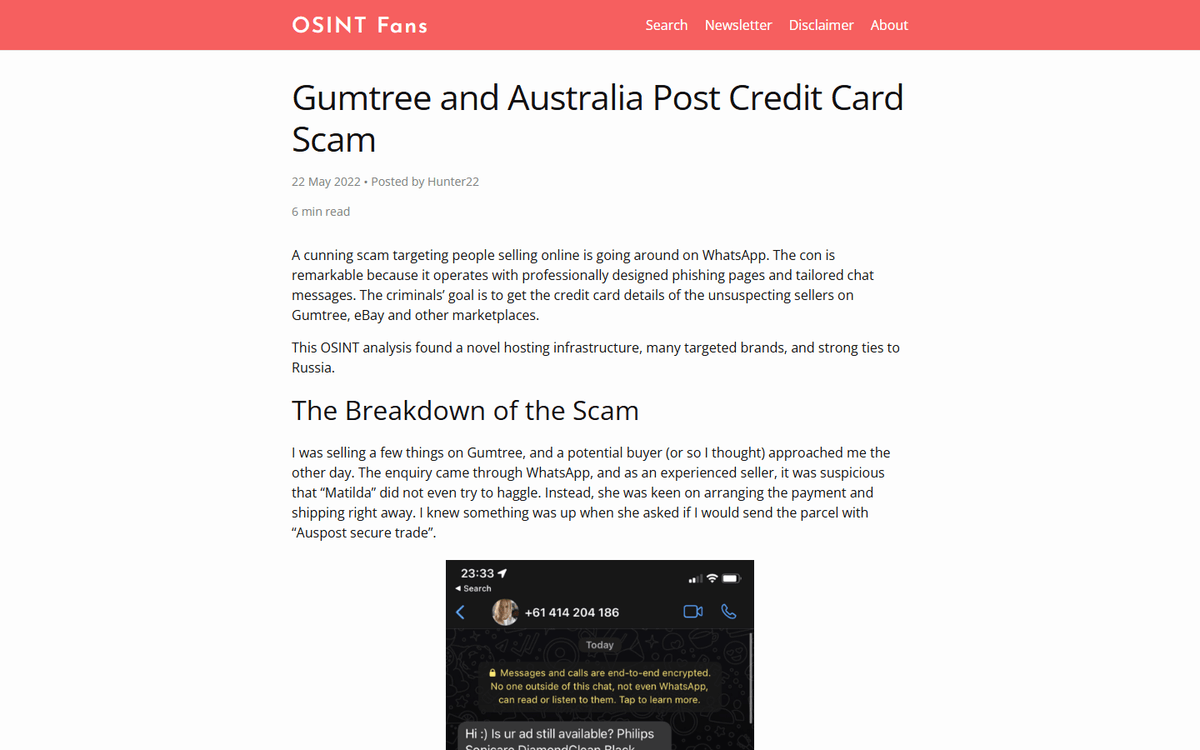
The homepage leads with “Latest Posts” and gives every entry the information a research reader needs to decide whether to continue: a date, estimated reading time, title, short summary, and direct article link. Topics range from an analysis of a Gumtree and Australia Post phishing scenario to a self-hosted VPN guide and a multi-part investigation of a phishing service.
This restrained layout supports scanning. There is no large promotional introduction between the visitor and the archive. Older posts remain reachable through pagination, and search offers a second route for readers who arrive with a particular subject in mind. RSS is especially appropriate for a technical audience because it lets readers follow updates without depending on a social feed.
Long-Form Articles Turn Incidents into Reusable Knowledge
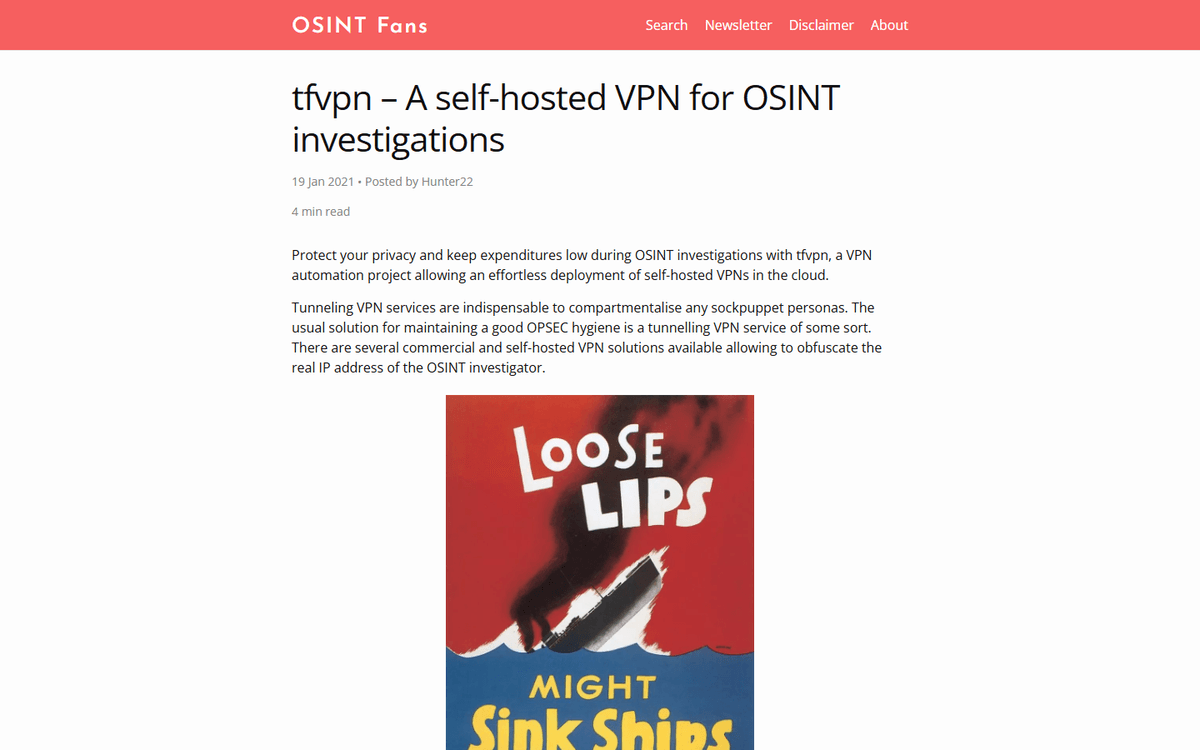
The phishing case study begins with a suspicious buyer conversation and then moves into the mechanics of the scheme. The tfvpn guide takes a different approach: it starts from the operational problem of separating investigation identities and discusses a self-hosted tool. Together, these pages show that the publication is not organized around one repetitive content format.
For a specialist publisher, that variety is productive. Incident breakdowns can document how a particular abuse pattern unfolds. Tutorials can help readers establish safer working practices. Series can divide a complex investigation into manageable parts. The unifying factor is the audience's need, not an arbitrary article template.
Editorial Boundaries Are Part of the Experience
Security research carries obvious risks. Readers may act on incomplete information, external links can change, and investigative claims can affect real people or organizations. OSINT.fans places a Disclaimer link in its primary navigation. The page describes the site as a personal blog, separates its views from outside institutions, and warns readers that external destinations may change.
A disclaimer does not replace careful sourcing or responsible publication. It does, however, make the editorial boundary visible. A niche publisher should also review sensitive screenshots, remove unnecessary personal data, avoid giving operational instructions that enable abuse, and correct material when new evidence changes the picture. Trust is created by the full publishing practice, not by a domain name alone.
Four Lessons for Specialist Publishers
- Name the field clearly. A direct subject-domain combination helps qualified readers understand the focus immediately.
- Design for retrieval. Search, pagination, concise summaries, and RSS make an archive more valuable after publication day.
- Use formats that fit the evidence. Tutorials, case breakdowns, and multi-part investigations serve different learning needs.
- Publish the boundaries. About, privacy, correction, contact, and disclaimer information should be easy to reach.
What This Case Does Not Prove
The public site does not provide evidence about traffic, subscriber numbers, commercial results, or search ranking, and none should be inferred. Its dated archive also means readers should check whether older tools, services, and security advice still apply before acting. The useful observation is narrower: the website remains a coherent, accessible knowledge destination with a memorable address and practical archive features.
Teams planning a similar publication can review how a fan-focused domain supports identity, browse the .fans blog, and check naming options through the domain registration page. A name should still be paired with a realistic editorial schedule, clear ownership, and a policy for maintaining older content.
Conclusion
OSINT.fans shows how a small specialist publication can make its subject the center of the experience. The domain names the community, the homepage exposes the archive, and supporting pages establish practical boundaries. Its strongest lesson is not about publishing more. It is about giving focused research a stable structure in which useful work can remain discoverable over time.