
Sports supporters do not experience a season as a tidy sequence of webpages. They check a score during a commute, follow play-by-play while another match is on television, compare a table after the final whistle, and look ahead to the next fixture. Many follow several teams, competitions, and even sports at once. A useful live-score product must make that moving stream of information feel personal without hiding the wider sporting world.
tribe.fans approaches the problem from the supporter's point of view. Its web experience centers on what is happening now, while its MyTribe area gives people a way to shape the service around the teams and competitions they care about. The product's own positioning describes a destination that represents sport as people think about it rather than as organizations divide it. That idea is visible in the breadth of the experience.
A Fan-Centered Name for a Multi-Sport Product
The domain tribe.fans does two jobs. “Tribe” suggests a group joined by shared loyalty, while “.fans” makes the product category immediately understandable. The result is short, memorable, and flexible enough to cover many sports without sounding tied to a particular league or governing body.
That flexibility matters because the platform spans sports including rugby union, rugby league, football, cricket, basketball, netball, American football, Australian rules football, and forms of hockey. A league-specific name could become restrictive as coverage grows. A fan-specific domain keeps the focus on the common behavior shared across all of those audiences: following the action.
This is a practical example of why community platforms choose a .fans domain. The address does not need a long explanation to tell visitors that it was built for supporters.
“What's On” Matches the Urgency of Live Sport
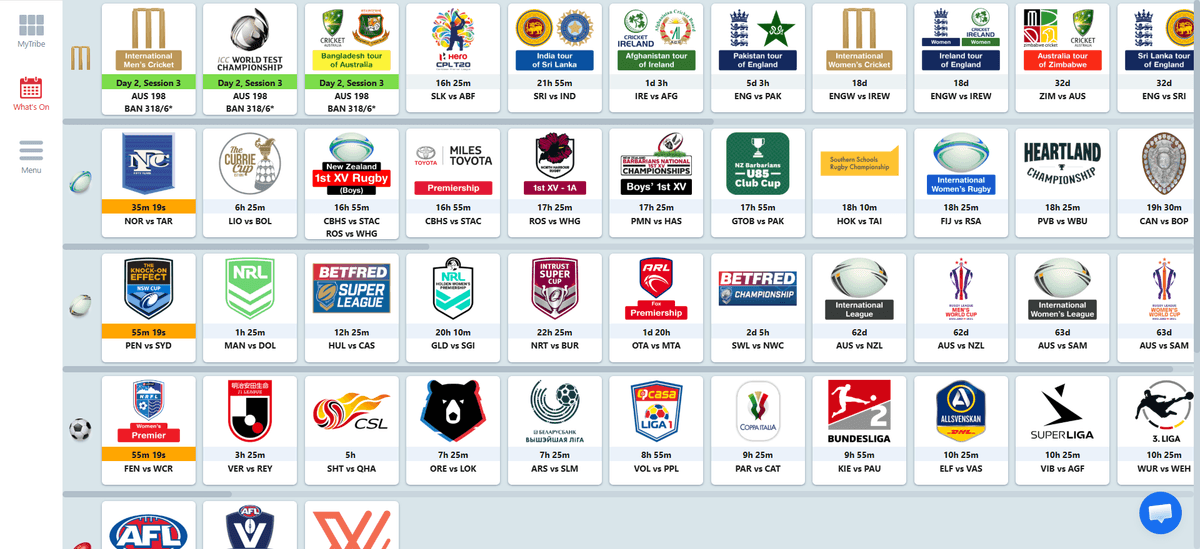
For a score product, the first screen has to answer a time-sensitive question: what can I follow right now? Tribe's “What's On” framing is more natural than forcing a visitor to navigate an organizational hierarchy before seeing active events. It can bring current and upcoming matches into one view, then let the supporter move into a specific game for more detail.
That event-level experience can include the score, status, fixtures, competition context, tables, and play-by-play information where available. The exact depth naturally varies by sport and event. The important design principle is consistency: once a user learns how to inspect one match, the same mental model can help them move across competitions.
Live data is also inherently changeable. A delay from a data provider, a postponed fixture, or a competition with limited coverage can produce temporary gaps. A strong product treats those conditions as part of the service rather than pretending every event is identical. Users should still confirm critical venue or broadcast details through the relevant organizer.
MyTribe Turns a Broad Database into a Personal Routine
Wide coverage is valuable, but it can become noisy. The MyTribe concept solves that problem by allowing supporters to prioritize favorites. Instead of searching for the same club or league every day, users can create a more relevant starting point around the identities they already follow.
This personalization creates a useful balance:
- Favorites reduce effort: recurring teams and competitions remain close at hand.
- Live views preserve discovery: supporters can still see what else is happening across sport.
- Shared account behavior adds continuity: preferences can follow the user between web and mobile experiences.
- Cross-sport organization reflects real fans: a person can follow a football club, a rugby side, and a national cricket team without adopting separate habits for each one.
The model recognizes that fandom is both selective and curious. People want fast access to their own teams, but major finals, rival results, and international events can still pull their attention elsewhere.
The Mobile Interface Fits the Checking Habit
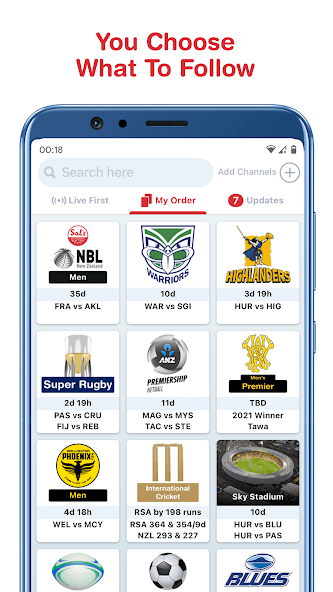
Tribe is also available as a mobile app, and the official store imagery shows a compact interface designed around scores and event cards. That format fits the way live sport is consumed: quickly, repeatedly, and often with one hand. A clear app icon and recognizable visual system help turn those short checks into a routine.
The strongest sports interfaces are not judged only by how much data they contain. They are judged by how quickly a supporter can answer a small question. Has the match started? Who scored? What is the table now? When is the next game? Tribe's product structure is oriented toward those moments rather than toward long editorial sessions.
Lessons for Other Fan Platforms
Community builders can take several lessons from tribe.fans even if they are not developing a live-score service. First, organize information around audience intent. “What's On” is a human question, while a database category is an internal structure. Second, allow people to declare what matters to them. Favorites transform a large content catalog into a personal tool. Third, preserve a route back to discovery so personalization does not become a closed loop.
The product also shows the value of a domain that can stretch with the service. The .fans use-case directory includes many different community models, from creators to publications and sports destinations. Tribe demonstrates that the extension can support a broad utility product as long as fans remain the organizing idea.
A Useful Home for the Daily Sports Loop
When reviewed on August 11, 2026, tribe.fans was active, with its dynamic web application serving current sports information and its mobile listing available through Google Play. The combination of live discovery and a personalized MyTribe area gives the product a clear role: it is a repeat destination for the daily loop of checking, following, and looking ahead.
The case is especially relevant for products that need to serve several communities without losing a coherent identity. Tribe does not define itself by one sport. It defines itself by the supporter behavior shared across sports. The domain reinforces that choice every time someone types or shares the address.
A fan platform earns repeat visits when it becomes useful in small, frequent moments. Clear navigation, relevant defaults, portable preferences, and a recognizable community name can do more than a crowded feature list. Organizations ready to build their own repeat destination can start by exploring how to register a .fans domain.