
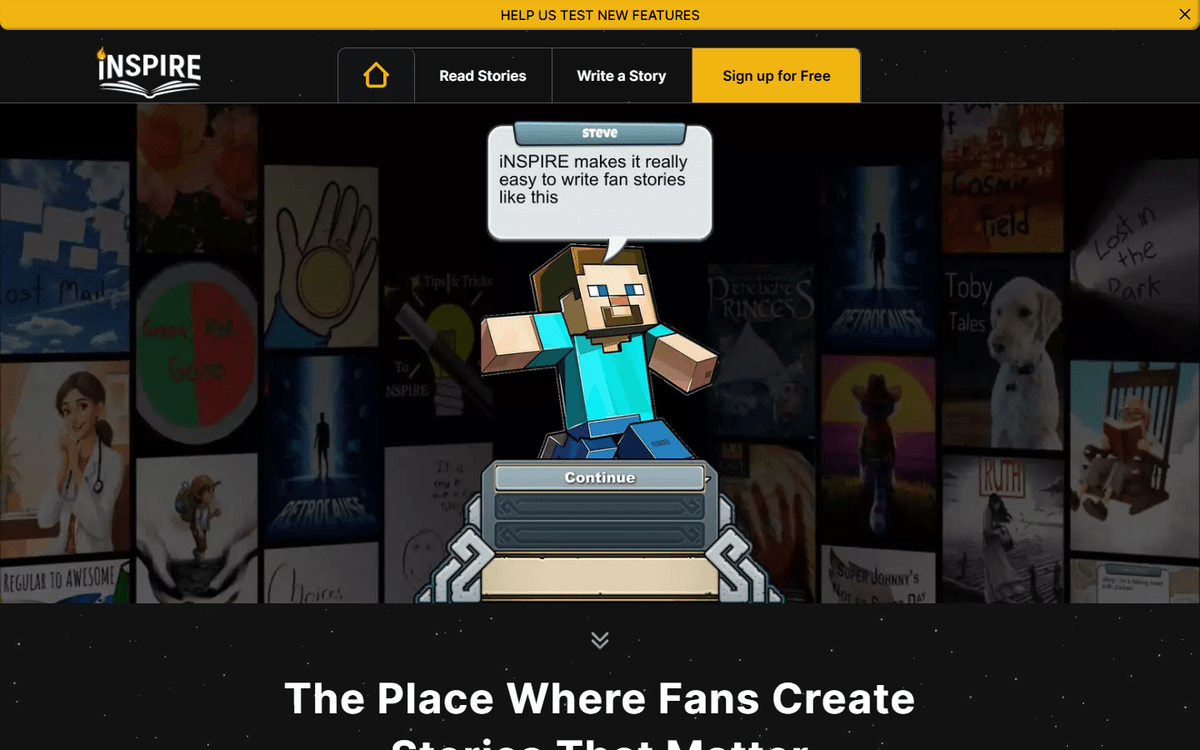
Many fandom websites are built primarily for consumption: visitors read an update, watch a clip, or browse an archive. iNSPIRE.fans takes a more participatory approach. Its public homepage invites visitors to read stories, write a story, join challenges, learn narrative skills, and use assisted creation features.
The platform presents fan fiction, choose-your-own-path narratives, adventure stories, comics, and storybooks as part of one creative environment. That breadth makes it an instructive case for communities that want members to contribute, not merely follow. It also raises important questions about user-generated content, privacy, AI disclosure, and third-party intellectual property, all of which belong in a balanced review.
Case Snapshot
- Website: inspire.fans/en
- Category: interactive storytelling and fan-creation platform
- Audience: readers, writers, parents, and people experimenting with visual or branching narratives
- Public features: story discovery, writing route, tutorials, challenges, AI-assisted features, account signup, and pricing
- Activity checked: August 19, 2026
The Experience Begins with Two Equal Roles
The primary navigation gives “Read Stories” and “Write a Story” similar prominence. This small decision establishes the platform's model: every reader may become a creator, and every creator needs an audience. A free signup route sits beside those actions, making registration a means to participate rather than the only thing visible on arrival.
The homepage reinforces that loop with public story covers and calls to read more. The visual language resembles a playful story universe rather than a conventional publishing dashboard. For a creative audience, that atmosphere can reduce the distance between seeing someone else's work and imagining a first contribution.
Learning Content Supports the Creation Tool
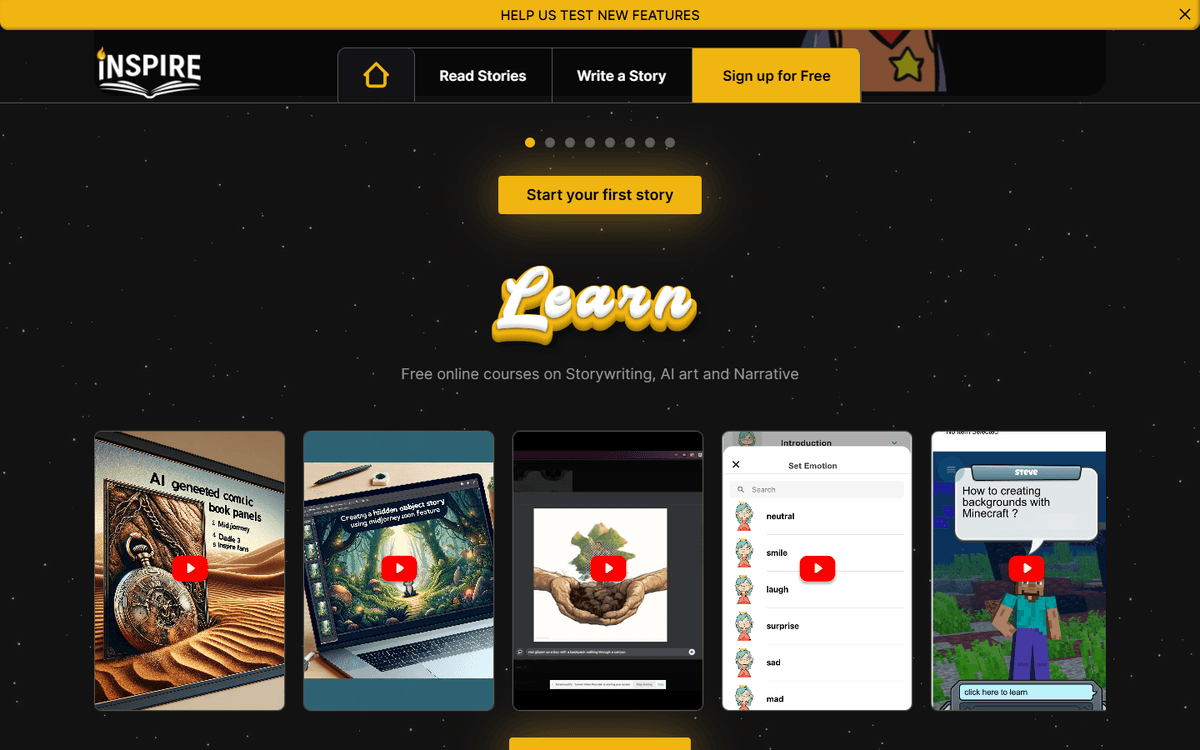
iNSPIRE does not rely only on an empty editor and a blank-page prompt. The site highlights free online courses covering story writing, AI art, and narrative. It also displays visual tutorials related to comic panels, hidden-object stories, backgrounds, emotions, and character-driven scenes.
This is a valuable product lesson. A creation platform often assumes users already know how to create. In practice, examples and short learning modules can be part of the onboarding system. They show the kind of work the platform supports and give uncertain users a manageable next step.
Challenges Add a Shared Prompt
The homepage includes a challenge area with a completion task, ranking language, and a reward called Sparks. A displayed challenge was marked as ended, so this article does not treat it as an active competition. The enduring design idea is still visible: a shared prompt can turn individual creation into a community event.
Challenges work best when rules, dates, eligibility, judging, prizes, and content rights are easy to find. They should also be accessible to new participants rather than rewarding only the most established accounts. Community operators can use the .fans use-case collection to compare other ways of organizing audience participation.
AI Features Are Framed as Creative Assistance
The site describes several assisted capabilities: generated characters and assets, suggested plot lines, role-play with characters, narrated audio, and suggested emotions. The page's central framing is coaching and support while the user writes. That positioning is more specific than placing a generic “AI-powered” label over the entire experience.
Creators still need transparency. Users should know which elements are generated, what data is sent to third-party services, whether their prompts or stories are retained, and what rights apply to outputs. The public privacy policy is dated February 2022 and discusses device information, cookies, log files, and optional Google sign-in. Because features and vendors can change, account holders should review the latest policy and terms before sharing unpublished or personal material.
Why the .fans Name Fits Participation
The name “inspire fans” can be read in two useful ways: it describes a destination for fans, and it suggests that fans can inspire one another through stories. The extension is therefore connected to the product behavior, not simply attached to a brand word.
That relationship illustrates the idea behind a fan-centered web identity. A strong domain should set an expectation that the interface fulfills. Here, reading, writing, sharing, challenges, and feedback all point toward participation.
Lessons for Creative Community Platforms
- Give readers and creators clear entrances. Discovery and production should reinforce each other.
- Teach the medium. Tutorials can be a core product feature, not an afterthought in a help center.
- Use shared prompts carefully. Challenges need dates, rules, rights terms, and transparent rewards.
- Describe AI by task. “Plot suggestion” or “narrated audio” tells users more than a broad AI badge.
- Build safety into publishing. Reporting, moderation, age-appropriate controls, and privacy guidance matter wherever users share stories.
Rights and Affiliation Boundaries
Public story covers and examples may reference recognizable genres, characters, or entertainment properties. Their appearance on a user-generated platform does not establish endorsement by a studio, game publisher, artist, or rights holder. A responsible service should provide clear copyright reporting procedures and explain what contributors may upload.
Likewise, this case study does not evaluate story quality, subscriber counts, or the accuracy of pricing beyond what was visible during review. Creators researching a similar project can use the .fans FAQ and domain search route, while separately checking trademarks and platform-policy obligations.
Conclusion
iNSPIRE.fans is a useful example of a fandom destination built around making. Its strongest pattern is the path from reading to learning to writing: public stories provide inspiration, tutorials reduce the first-step barrier, and assisted tools offer scaffolding. For a creative community, the memorable domain works because the product gives fans something meaningful to do together.