
Technical communities accumulate knowledge quickly, but that knowledge is often scattered across videos, chats, forum posts, and personal notes. Evernode.fans takes a focused approach: it presents itself as an educational website about Evernode and organizes learning material into separate tutorial and video libraries.
The site does not need to be treated as the official Evernode website to be useful. Its public value is visible in the collection itself. Visitors can browse beginner wallet guidance, developer setup material, web-app deployment instructions, smart-contract examples, liquidity walkthroughs, and community project videos from one memorable address.
Case Snapshot
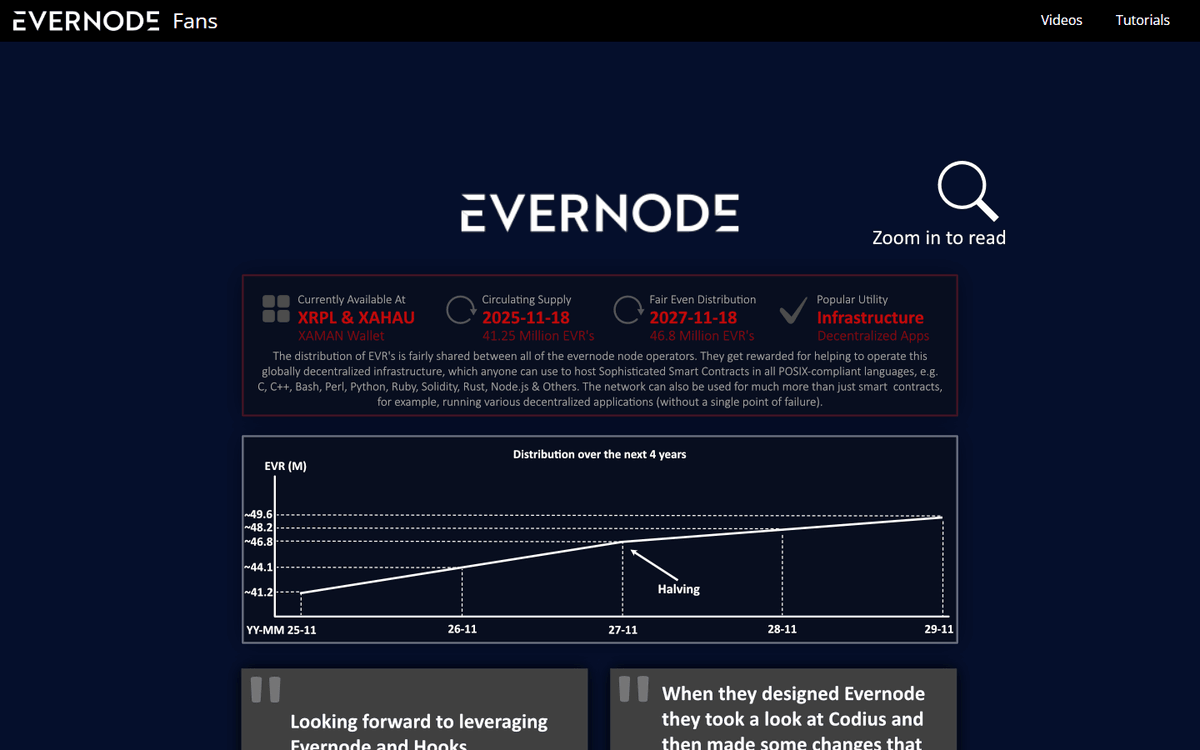
- Website: evernode.fans
- Category: community-built technical education hub
- Audience: Evernode newcomers, application developers, node operators, and ecosystem participants
- Public features: searchable tutorials, categorized videos, educational infographic, and community links
- Activity checked: August 19, 2026
The Homepage States a Narrow Mission
The homepage says the website is “purely made for education about evernode.” That direct statement establishes a useful boundary. It does not attempt to be a price dashboard, corporate newsroom, wallet, block explorer, and documentation portal all at once. Instead, the interface points visitors toward Videos and Tutorials.
A long Evernode information graphic gives the homepage visual context, while Discord, Telegram, and forum icons connect the learning library with discussion spaces. The structure reflects a common community journey: understand the concept, follow a practical guide, then ask questions or compare experiences with other participants.
Two Libraries Serve Different Learning Modes
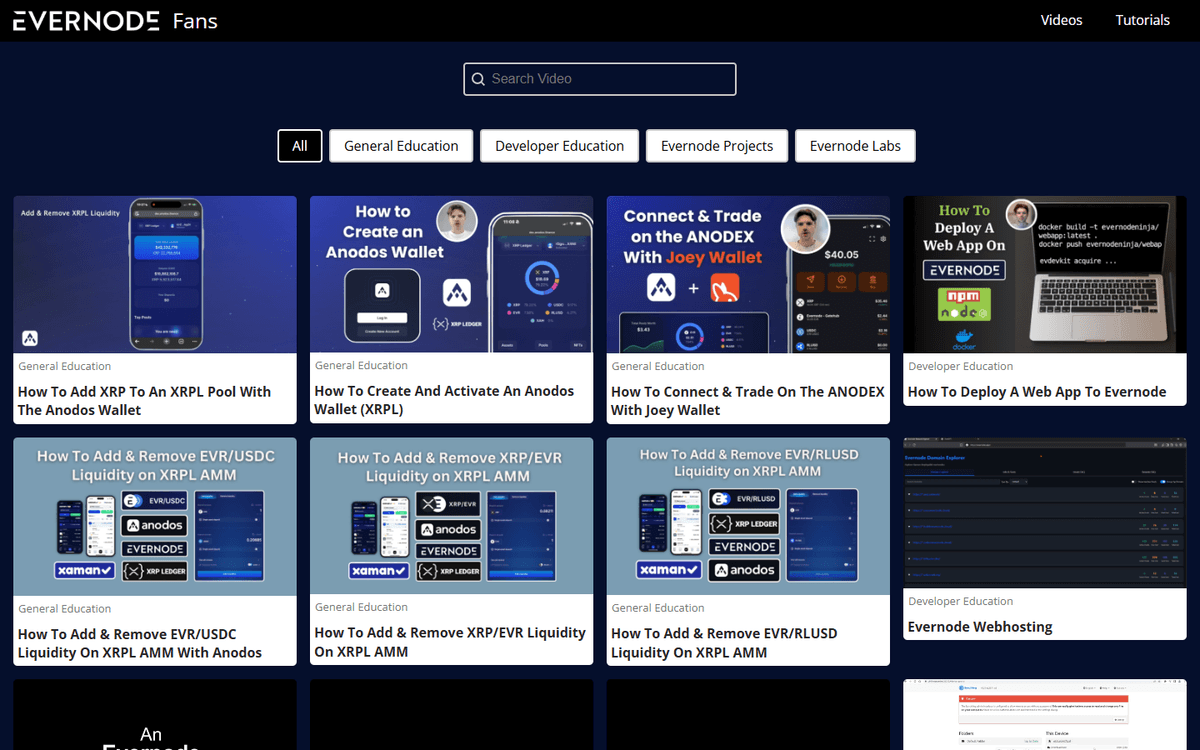
The Tutorials page uses search and category filters for Developer Education and General Education. Visible topics include deploying a first web app, creating a simple Node.js website, setting up an Evernode node, preparing wallets and trustlines, using a code environment, and deploying a smart contract.
The Videos page applies a similar interface to a broader catalogue. Its categories include general education, developer education, Evernode projects, and Evernode Labs. Visible entries cover wallet tasks, exchange connections, liquidity, hosting, clusters, file-sharing contracts, and encrypted synchronization. A “Load more” control indicates that the first screen is only part of the available collection.
Keeping tutorials and videos separate is a sensible information-architecture choice. A reader following commands may prefer a text sequence that can be scanned and copied. Someone learning an interface may prefer a narrated demonstration. Both formats remain under the same recognizable identity.
Search and Categories Reduce Technical Friction
A knowledge library becomes harder to use as it grows. Evernode.fans addresses that problem with a search field and broad audience categories. The categories are simple, but they answer an important question: is this material for someone trying to understand the ecosystem, or for someone preparing to build and deploy?
Other community documentation projects can extend the pattern with prerequisites, difficulty levels, operating-system labels, update dates, tested software versions, and expected completion time. Those details help readers choose the right guide and recognize when older instructions may no longer match a current release.
The Domain Names the Learner Community
Evernode.fans reads as a destination created around shared interest in Evernode. That makes it appropriate for educational material contributed or curated by community members. The name is short enough to mention in a video or community chat, and its purpose is clearer than a generic folder inside an unrelated personal domain.
This is one of the practical roles described across different .fans use cases: a domain can become the stable index behind activity that happens on multiple platforms. The videos may be embedded from YouTube and discussions may continue on Discord or Telegram, but the learning catalogue has its own home.
Privacy Notes Set Useful Expectations
The footer explains that visitor IP addresses are logged and that logs are purged frequently. It also says the site does not store tracking cookies or use Google Fonts, while embedded YouTube clips can still allow YouTube and Google to learn which videos a visitor watches.
That service-specific explanation is more informative than a vague “we value privacy” statement. It distinguishes the website's own practices from the behavior of embedded third-party media. Community publishers should maintain the same clarity whenever they add analytics, video players, comment systems, payment tools, or external forms.
Five Execution Lessons
- Give the educational project a narrow, explicit purpose.
- Separate text tutorials and video demonstrations while keeping navigation consistent.
- Add filters that reflect audience needs, not only internal project terminology.
- Connect learning material to discussion spaces without making chat history the only documentation.
- Explain third-party embeds and data handling in language visitors can understand.
Technical and Financial Boundaries
Several guides involve wallets, tokens, trustlines, liquidity, or smart contracts. Their presence in a library does not guarantee that every instruction is current, secure, or suitable for every reader. Users should verify commands against current project documentation, test with limited-value environments where possible, protect keys and recovery phrases, and understand transaction risks before acting.
The website also provides no public evidence in the reviewed pages about traffic, completion rates, or learning outcomes. Its lesson is organizational rather than quantitative. Communities considering a similar resource can review the role of a fan-focused identity, check the .fans FAQ, and explore naming through the registration page.
Conclusion
Evernode.fans turns a technically broad subject into a navigable learning destination. Its separate libraries, visible categories, search tools, community routes, and privacy notes all support the same educational mission. The case shows that a useful fan community website does not have to reproduce every social feature; sometimes its most valuable role is to organize the knowledge a community already creates.