
A domain can support a community without hosting a publication, membership program, or social feed. xrp.fans demonstrates another model: a compact developer utility. The page identifies itself as an XRPL Developer Dashboard and displays live information from public XRP Ledger server connections.
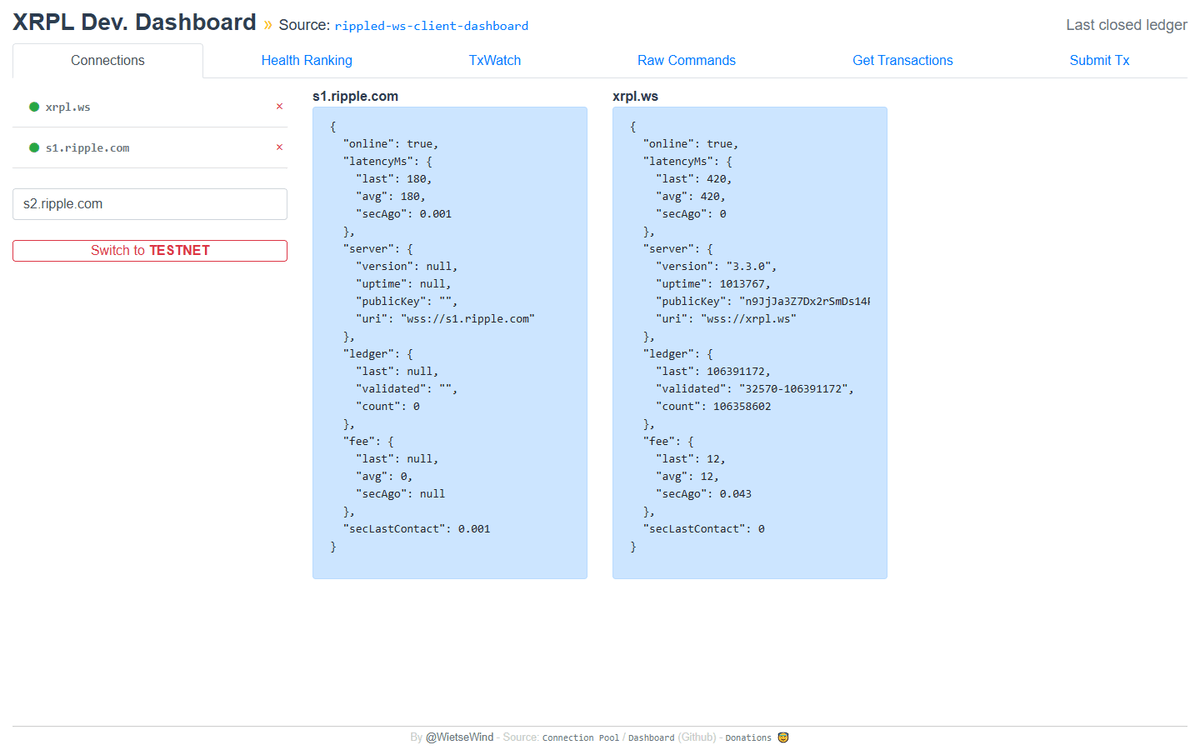
When reviewed, the interface showed connection status, latency, server metadata, ledger ranges, fee data, and last-contact timing for endpoints including xrpl.ws and s1.ripple.com. Tabs also expose health ranking, transaction watching, raw commands, transaction retrieval, and transaction submission. The footer credits Wietse Wind and links to the dashboard and connection-pool source code on GitHub.
Case Snapshot
- Website: xrp.fans
- Category: open developer dashboard for the XRP Ledger
- Audience: XRPL developers, infrastructure operators, testers, and technically curious community members
- Public features: server connections, health ranking, ledger monitoring, raw commands, transaction lookup, and submission tools
- Activity checked: August 19, 2026
The Interface Opens with Evidence, Not Explanation
The first screen is deliberately technical. A connection list appears on the left, while structured data panels show what each server reports. Green status indicators provide a quick signal, and JSON-like blocks expose the underlying values rather than hiding them behind a decorative score.
This is appropriate for the intended audience. A developer arriving to check an endpoint may care more about connection state, response timing, server version, ledger status, and fee information than about a broad introduction to blockchain. The interface respects that task by making the data visible immediately.
Tabs Turn One Page into a Small Workbench
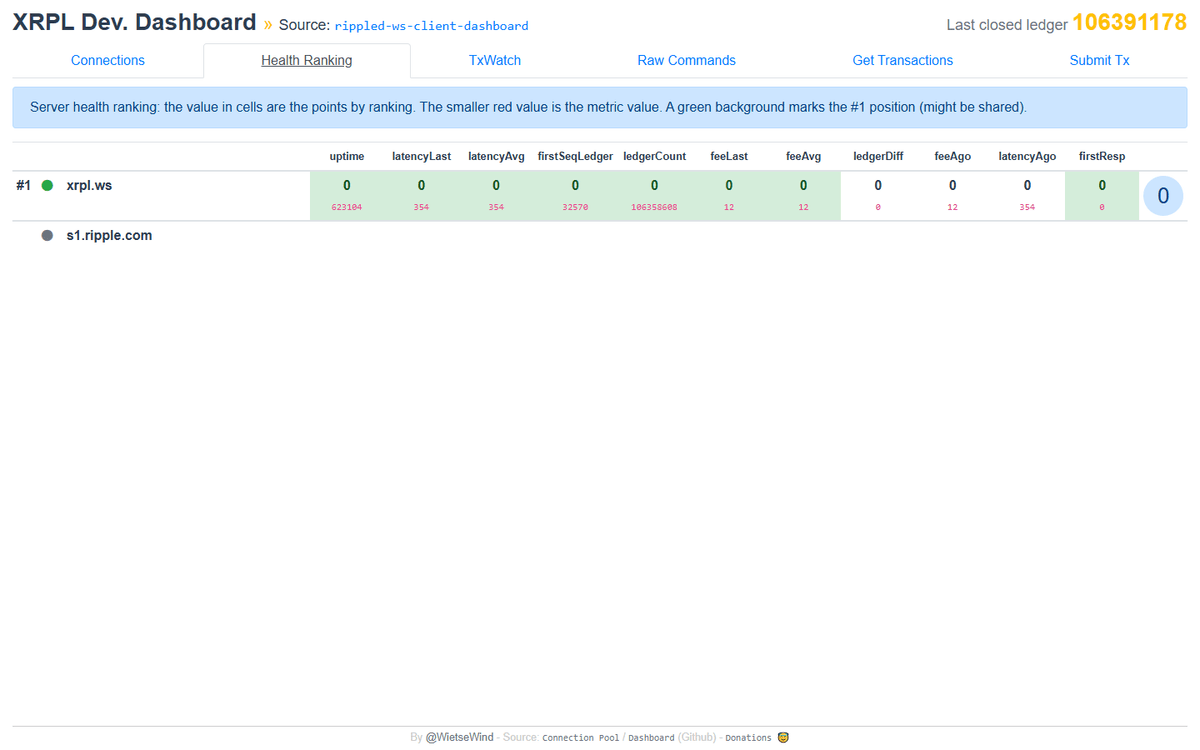
The Connections view is only the beginning. Health Ranking supports comparison, TxWatch focuses attention on transaction activity, and Raw Commands gives experienced users a direct way to interact with server methods. Separate areas for retrieving and submitting transactions extend the dashboard beyond passive monitoring.
These modes are grouped in one horizontal navigation rather than split across unrelated sites. That continuity matters when a user moves from observing network state to testing a query. It also gives the short xrp.fans address a clear product meaning: the domain is the entrance to a practical XRPL workbench.
Open Source Links Strengthen Technical Trust
The page links directly to the dashboard repository and the connection-pool repository. For a developer tool, this is more useful than a vague claim of transparency. Readers can inspect the implementation, review change history, and understand what the visible interface is built to do.
The official XRPL documentation explains that the network uses server software for peer-to-peer transaction processing and API access. It also notes that public servers can serve lighter use cases while more serious infrastructure needs may justify operating controlled servers. That context helps visitors interpret xrp.fans as a dashboard over network services, not as the XRP Ledger itself.
A Short Domain Can Serve a Highly Specific Utility
The combination of “xrp” and .fans is immediately recognizable to the relevant community. The site does not add a long product name between the user and the tool. That economy is useful for utilities shared in developer chats, documentation, live demonstrations, and support conversations.
This expands the range of practical .fans use cases. A fan-facing destination can be a working instrument for a technical ecosystem, provided the name does not misrepresent ownership or official status. The public page credits its creator and source repositories rather than claiming to be an official network portal.
Live Data Requires Careful Language
Every screenshot of this dashboard is a moment in time. Ledger numbers, latency, uptime, fees, server versions, and availability change. An article should therefore describe the kinds of information shown, not preserve temporary values as permanent facts. A red or green indicator may also reflect the visitor's connection, a server's state, or a brief network condition.
Transaction submission introduces a more serious boundary. Users should understand the selected network, inspect commands, protect credentials and signing material, and test with appropriate environments before sending anything. A convenient interface does not eliminate the consequences of a malformed or unintended transaction.
Lessons for Developer-Community Tools
- Lead with the primary task. Technical users should not have to dismiss marketing content to reach live data.
- Separate modes clearly. Monitoring, querying, and submitting are different actions with different risk levels.
- Link the source. Repository access gives developers a path to inspect, reproduce, and contribute.
- Label networks and endpoints. Mainnet, testnet, public servers, and custom servers must be visually distinct.
- Treat live values as transient. Timestamp captures and avoid turning temporary states into lasting claims.
What the Case Shows, and What It Does Not
xrp.fans shows that a community-oriented domain can host a focused technical utility with very little editorial wrapping. It does not establish that the displayed endpoints are always available, that every command is safe, or that use of the tool has any financial outcome. This article is an interface case study, not investment, security, or transaction advice.
Developers planning a comparable destination can read why a .fans identity can suit a focused audience, consult the .fans FAQ, and use the registration page to check naming options. Clear attribution and trademark review remain essential.
Conclusion
xrp.fans is compelling because the domain and interface share the same economy. The address is short, the audience is specific, and the page opens directly into live technical work. By pairing transparent data with linked source code and distinct tool modes, the site illustrates how a community domain can function as infrastructure rather than promotion.