
Creators often assemble their businesses from separate tools: a profile link for discovery, a payment service for transactions, a spreadsheet for customer details, a messaging app for conversations, and another dashboard for analytics. Every extra handoff creates friction for both the creator and the audience.
dropp.fans presents a more integrated model. Its public website describes an all-in-one platform for selling, managing, and scaling a digital creator business. The experience is organized into two memorable jobs: Sell and Scale.
Case Snapshot
- Website: dropp.fans
- Primary users: creators and teams operating digital audience businesses
- Sell tools: payment links, donations, wishlists, and paid chats
- Scale tools: CRM, workflows, AI-assisted chat, multi-account management, scripts, and analytics
- Status checked: August 11, 2026
Sell and Scale Create a Clear Product Story
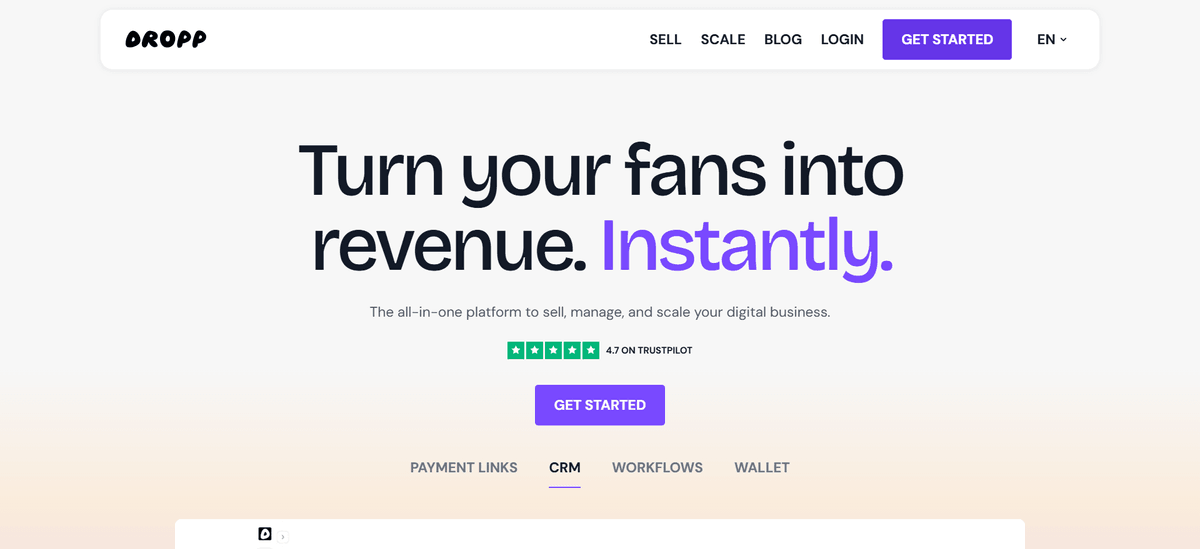
Many software homepages lead with a long matrix of features. Dropp instead gives visitors a simple progression. First, create something people can buy or support. Then, organize the resulting relationships and operations as the business grows.
This two-stage framing reduces cognitive load. A creator who only needs a payment link can understand the immediate value. A team already managing many conversations can see the next layer. The platform does not require every prospect to enter through the same level of complexity.
Payment Links Lower the Barrier to a First Transaction
The Sell section emphasizes quick payment-link creation, donations, wishlists, and paid chats. These formats fit the way creator audiences move between social networks, direct messages, livestreams, and private communities. A shareable link can travel with the conversation instead of asking the audience to navigate a large storefront.
Speed should not remove clarity. A responsible payment experience still needs to state what the supporter receives, whether the payment is recurring, what personal information is collected, and how refunds or disputes are handled. The easier it is to begin a transaction, the more important transparent terms become.
CRM Turns Transactions into Usable Relationships
A transaction tells a creator that someone cared enough to act. Without organization, however, that information may remain trapped in payment records. Dropp's Scale positioning brings customer relationship management, workflows, and analytics into the same product story.
The practical value is continuity. Teams can distinguish a new supporter from a repeat customer, keep conversations coordinated across accounts, and understand which offers need follow-up. This should be used to improve relevance rather than overwhelm people with messages. Consent, segmentation, and sensible contact frequency are essential.
Three Operational Layers
- Transaction: create a clear paid action and make it easy to share.
- Relationship: retain the context needed to support and serve the customer.
- Operations: use workflows, roles, scripts, and analytics to keep a growing team consistent.
The Domain Names the Business Relationship
The word "dropp" suggests a release, offer, or moment of availability. Paired with .fans, it also identifies who those offers are for. The name feels native to online creator culture without restricting the product to one content format.
This is a useful example of a platform using .fans at the infrastructure layer. The domain is not merely a fan club label; it communicates the audience relationship underlying payments, access, support, and retention. The official .fans creator examples include Dropp for that reason.
Public Policies Support a High-Trust Product
Dropp's footer links to terms, privacy information, AI terms, supported countries, and a complaints and removal policy. That supporting material matters because the platform handles payments, messages, creator content, and customer information.
Policy links alone are not enough; they must be current, understandable, and reflected in the product. Still, making them easy to find is a good baseline. Creator platforms should explain eligibility, moderation, payout timing, fees, prohibited use, account closure, data handling, and complaint routes before a problem occurs.
What Other Creator Platforms Can Learn
- Group features around the customer's stage, not the software team's internal modules.
- Let creators begin with one useful paid action before introducing advanced operations.
- Keep customer context connected to transactions and support conversations.
- Design multi-account tools for clear responsibility and auditability.
- Place trust, safety, privacy, and complaints information near the commercial journey.
Where Simplicity Needs Guardrails
Creator monetization can involve sensitive content, unequal expectations, chargebacks, impersonation, or unclear deliverables. Platforms should give both creators and supporters precise records and accessible support. AI-assisted chat also needs clear human oversight so automation does not misrepresent a creator or mishandle a customer request.
Teams exploring a direct-support destination can use the fan-first identity guide to define the audience relationship and the registration page to research available names. A relevant domain helps set expectations, but reliable operations earn trust.
Another useful design choice is separating the first sale from the systems needed later. A new creator can validate demand with a focused offer, while an established team can evaluate workflows and customer management. Showing that progression helps each visitor understand the next useful step without suggesting that every account needs maximum complexity on day one.
Conclusion
dropp.fans presents creator commerce as a progression from a simple shared link to an organized audience business. Its strongest lesson is clarity: help creators sell first, then give them the tools to manage relationships and scale responsibly. The .fans address keeps the beneficiary of that system visible. Behind every payment link, workflow, and dashboard is a person choosing to support a creator.