
Portuguese-language biology and STEAM hub associated on its public pages with teacher Arlik Rafael Santiago de Sousa. It brings science projects, fairs, quizzes, comics, videos, student work, and teaching-method pages into one destination.
The website is best understood as a teacher-led project ecosystem, not as an official institutional portal unless a school or authority separately confirms that status. Its value as a case lies in the structure: named initiatives can retain their own identity while remaining connected to a shared educational theme.
Case Snapshot
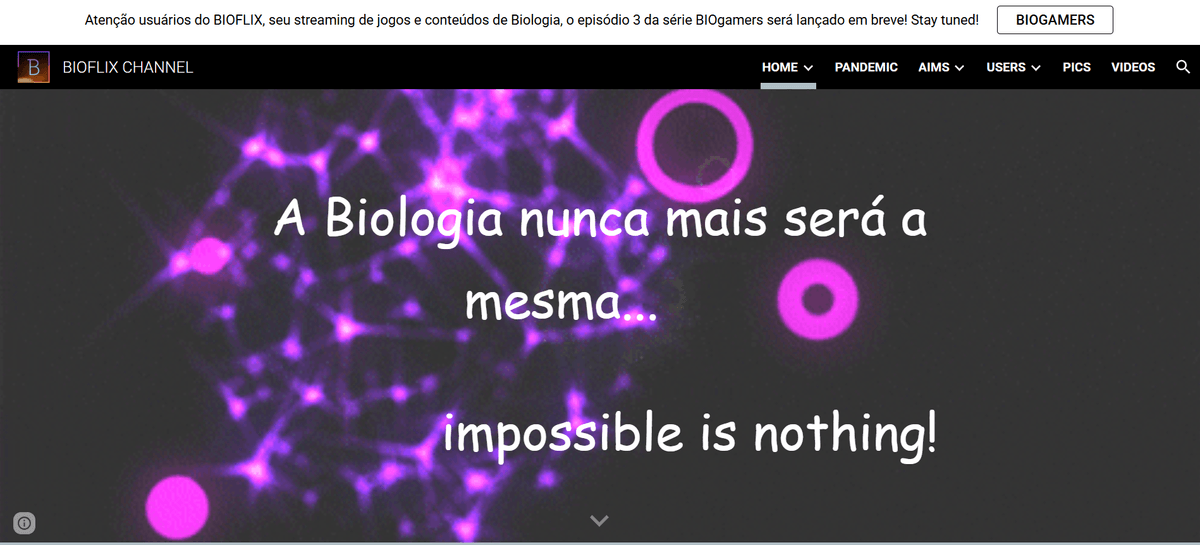
- Website: bioflixchannel.fans
- Category: biology and STEAM education hub
- Publicly identified creator: professor Arlik Rafael Santiago de Sousa
- Primary audience: students, educators, project collaborators, and people interested in biology learning
- Observed sections: BIOTECinova, BIOphilia, BIOtoons, BIOquiz, BIOcomics, games, projects, images, and videos
- Website checked: September 8, 2026
A Hub for Programs, Not Just Pages
The navigation presents a family of named activities rather than a single chronological blog. BIOTECinova focuses on a science fair. BIOquiz introduces game-like knowledge activities. BIOtoons and BIOcomics suggest visual storytelling, while image and video sections preserve media produced around the work.
This approach can make a complex educational practice easier to understand. Students may encounter one activity at a time, but teachers, families, and collaborators can see how experiments, presentations, media, and assessment relate. A shared site also gives past projects a longer life than classroom displays or temporary messaging groups.
BIOTECinova Makes the Learning Method Visible
The BIOTECinova area describes a science-fair context for full-time secondary students and collaborators. Its public material refers to STEAM, project-based learning, flipped-classroom ideas, and learning by doing. Examples span DNA extraction, fossils, solar ovens, compost, ecological products, health measurements, biomimetic robotics, 3D modeling, microbiology, and school gardening.
Listing project examples does more than showcase outcomes. It helps future participants understand the range of acceptable questions and methods. For other education hubs, each project page could go further by documenting the question, hypothesis, materials, safety review, procedure, evidence, limitations, credits, and reflection. That structure turns a gallery into a reusable learning resource.
Multiple Formats Support Multiple Ways of Learning
Quizzes, comics, games, photographs, and videos offer different entry points into biological ideas. A student who struggles with a long text may engage through a visual story or short challenge; another may use a project archive to plan an experiment. A teacher can combine those formats before, during, and after a lesson.
Variety is valuable only when the educational objective remains clear. Each resource should identify its intended level, learning goal, author, publication date, references, and revision history. Quizzes should explain answers rather than reward speed alone. Games and rankings should avoid exposing sensitive student data or turning classroom participation into public pressure.
Why the .fans Domain Fits an Education Community
The word “fans” is not limited to entertainment. It can also describe sustained curiosity: people who enjoy biology, follow a teacher's projects, or take pride in a shared science program. Paired with “Bioflixchannel,” the extension makes the destination sound like a channel for a learning audience rather than a formal administrative system.
That tone can make participation feel welcoming, especially when the site publishes student-created media. A community-oriented .fans address can provide continuity across school years and individual activities, provided that ownership, moderation, and institutional relationships are described accurately.
Scientific Review Must Accompany Creative Presentation
An attractive educational format does not validate every scientific statement. Teachers and students should check factual claims against current textbooks, peer-reviewed literature, recognized scientific organizations, and qualified subject experts. Experiments involving people, microorganisms, chemicals, electricity, heat, field sampling, or food require age-appropriate supervision, risk assessment, consent, and local rules.
This boundary is especially important when a public site mixes project summaries, wellness topics, games, and informal explanation. Readers should distinguish classroom exploration from established scientific consensus. Pages should correct errors transparently and retain enough sourcing for another educator to evaluate or reproduce the work responsibly.
Execution Lessons for Education Hubs
- Name recurring programs. Distinct initiatives are easier for students and collaborators to remember and revisit.
- Document the method, not only the result. Questions, evidence, safety, limitations, and reflection make projects reusable.
- Offer several learning formats. Quizzes, comics, video, and hands-on work can reinforce the same objective.
- Protect student participants. Consent, attribution, privacy, accessibility, and removal procedures should be designed before publication.
- Review scientific accuracy. Creative presentation should be paired with references and subject-matter checking.
Image and Student-Work Boundaries
The Bioflixchannel website states that its images may not be extracted, used, or shared by non-subscribers. For that reason, this case does not provide republishable screenshots or copied artwork. Publishers should obtain written permission from the relevant rights holder before using any image from the site.
Education projects also need clear consent for student names, faces, voices, submissions, and performance data. Consent should be specific, revocable where appropriate, and understandable to students and guardians. Public recognition can be meaningful, but participation in a class should not automatically become permission for unrestricted online publication.
Practical Takeaways
A teacher or project leader can start with a simple content model: program, learning objective, participants, method, evidence, outcome, reflection, references, permissions, and update date. Build one consistent project-page template, then connect quizzes, media, and galleries back to those records. An archive should help the next group learn from previous work rather than simply celebrate it.
Teams considering a memorable educational community address can review the .fans identity overview, consult the .fans FAQ, and check a project name on the registration page. The name should remain stable even as classes, tools, and projects change.
Conclusion
Bioflixchannel.fans illustrates how one address can connect a teacher's recurring science initiatives, student outputs, and multiple learning formats. Its strongest lesson is organizational: a learning community becomes easier to understand when programs have distinct identities but share a coherent archive. The `.fans` domain gives the hub an enthusiastic, audience-centered tone. Careful scientific review, student privacy, consent, and image rights are what make that public enthusiasm responsible.