
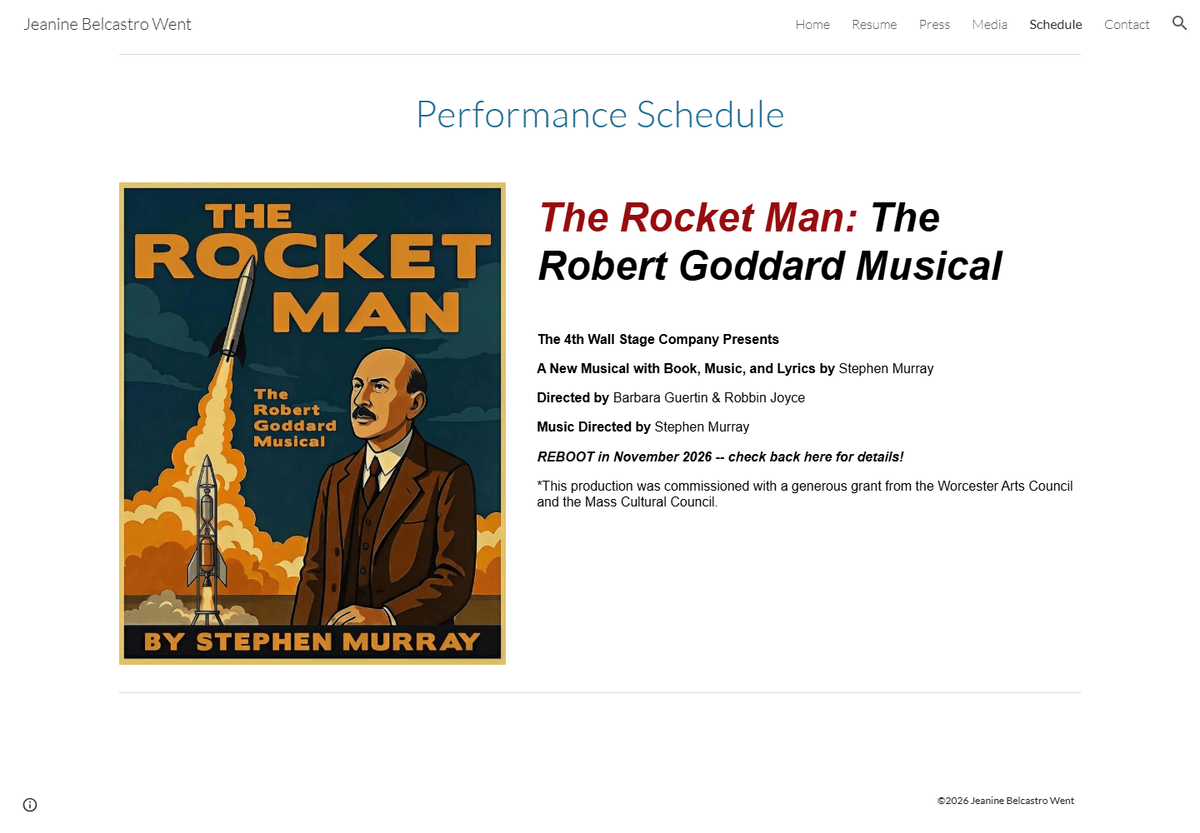
Jeanine.fans is the professional website of singer, actor, and director Jeanine Belcastro Went. Its homepage introduces her with a large portrait and a compact selection of critical comments, while the rest of the site organizes the materials that presenters, directors, collaborators, journalists, and audience members may want next.
This is a useful `.fans` case because the address does not lead only to a social feed or a promotional splash page. It works as a durable performing-arts portfolio. A resume, press coverage, selected recordings and video, an upcoming-performance page, and direct contact information all sit under one identity that is easy to say aloud and easy to print on a program.
Case Snapshot
- Website: jeanine.fans
- Category: performing arts and personal portfolio
- Primary audience: casting teams, producers, directors, journalists, collaborators, and theater audiences
- Main purpose: present Jeanine Belcastro Went's work, press, media, schedule, and contact path
- Observed features: professional portrait, review excerpts, resume, press links, performance recordings, production information, schedule, and contact page
The Homepage Establishes the Performer Before the Credits
The opening page uses a simple two-column composition. Jeanine's name and the roles “Singer/Actor/Director” appear beside a professional portrait. Short quotations attributed to publications including The Boston Globe, Providence Journal, Metrmag, Theatre Mirror, The Patriot Ledger, Cranston Herald, The Middletown Record, and The Daily Freeman create a quick sense of critical context.
That sequence is effective for a performer. Visitors first see a person, then a professional identity, then outside observations about the work. The page avoids forcing a reader through a long biography before reaching evidence. Photo credit is also visible, an important practice for a portfolio that depends on professional imagery.
Resume and Press Serve Different Decisions
The navigation separates “Resume” from “Press.” A resume is a structured record that helps a casting or production team evaluate experience. Press material answers a different question: how has the work been described publicly? The press page links to a feature about Jeanine performing in a production of A Christmas Carol and to an earlier profile in Little Rhody Theatre.
Keeping those routes separate makes the website easier to scan. A professional visitor can go straight to credentials, while an audience member or journalist can explore narrative coverage. Similar creator sites should resist combining every item into one endless biography; information works better when each page supports a clear visitor task.
Selected Media Lets Visitors Experience the Work
The media page adds sound and motion to the written record. It points visitors toward recordings from The Rocket Man, a Norton Singers anniversary segment, a cabaret performance, and a self-performed cover. The page also identifies Jeanine's contribution to individual songs or segments rather than presenting a generic video wall.
That labeling matters. A useful portfolio should tell the viewer what to notice: the production, the role, the song, the collaborators, or the relevant time range. Embedded media can disappear when a hosting service changes, so creators should periodically test each item and preserve master files, captions, credits, and permissions outside the public website.
The Schedule Makes the Site Operational
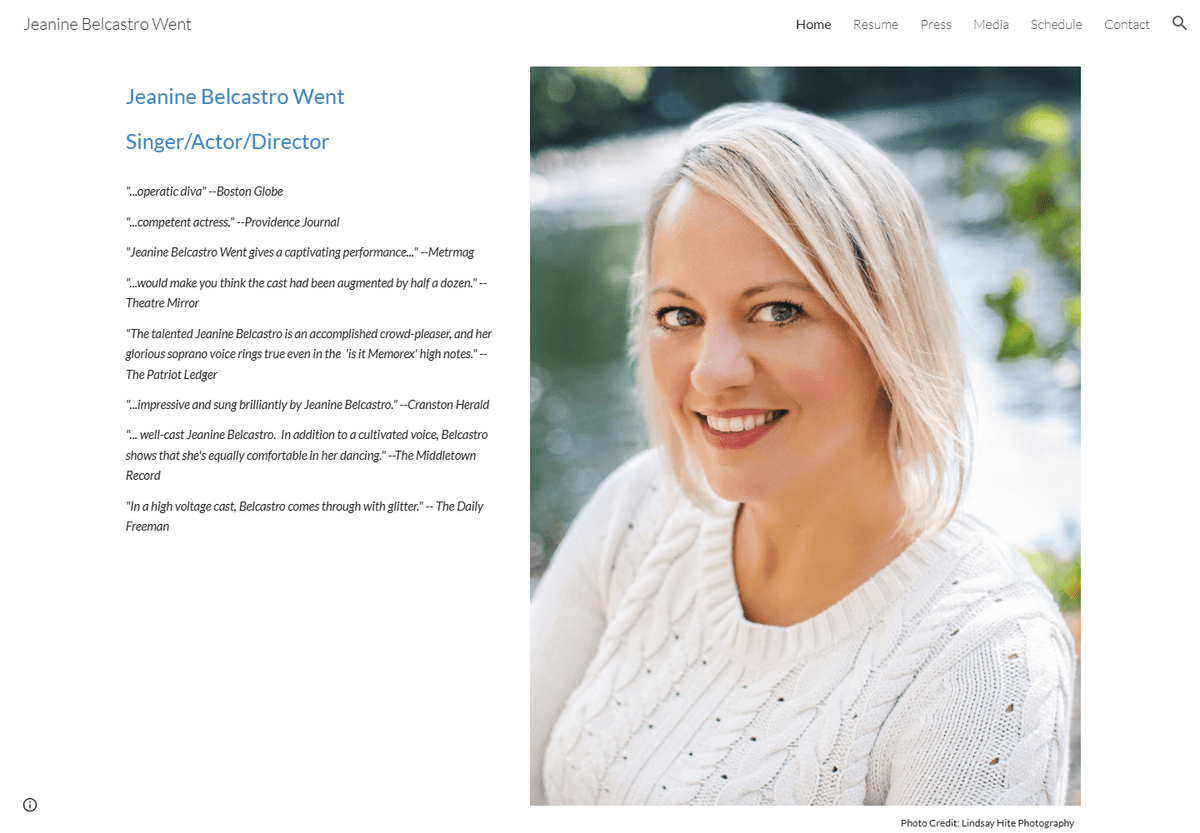
A portfolio becomes more valuable when it also supports the next audience action. The schedule page names The Rocket Man: The Robert Goddard Musical, identifies the producing company and creative team, and tells visitors that a return is planned for November 2026 with details to follow. This turns the website from a retrospective archive into a living point of reference.
Future updates could make that route even stronger with venue details, accessible ticket links, dates, time zone information for online events, and an archive that moves completed engagements into a past-performances section. The key is to keep one stable schedule address even as individual productions change.
Why the .fans Domain Fits
A personal performing-arts site has several audiences at once. Industry visitors need evidence and contact details; existing supporters want media and dates; new viewers may arrive after seeing a production. The `.fans` ending welcomes that public audience without preventing the site from functioning as a serious professional portfolio.
The fit is especially clear because the domain uses Jeanine's first name and the page immediately supplies her full professional identity. The address is personal, while the content provides the specificity needed for discovery and trust. The broader .fans use cases demonstrate how creators can use an audience-oriented domain without giving up practical professional functions.
Execution Lessons for Performer Websites
- Lead with identity and a strong portrait. Visitors should understand the person and discipline before they encounter a long list of credits.
- Separate evidence by purpose. Resume, press, media, schedule, and contact pages support different decisions.
- Label media precisely. Name the production, contribution, collaborators, and relevant segment so viewers know what they are evaluating.
- Keep upcoming work current. A schedule should remove stale calls to action and preserve completed work in an archive.
- Credit creative contributors. Photographers, musicians, directors, companies, and publications should remain connected to the work shown.
Rights, Accessibility, and Maintenance
Performing-arts portfolios often combine photographs, reviews, music, video, logos, and production information owned by different parties. The website should use material with permission, quote criticism sparingly, link to the original publication where possible, and identify collaborators accurately. Captions and transcripts can make audio and video more accessible, while descriptive alt text gives portfolio images meaning beyond visual presentation.
The site should also distinguish public booking information from private personal data. A dedicated professional contact route is safer and easier to maintain than publishing sensitive details. Because embedded players and outside articles may change, routine link checks are part of the portfolio itself, not merely technical housekeeping.
Practical Takeaways
A performer building a similar site can start with six durable modules: identity, resume, selected press, selected media, upcoming appearances, and contact. Each item should be edited for relevance rather than completeness. A few well-labeled examples often help a visitor more than an unfiltered archive.
The .fans identity overview explains the audience signal carried by the extension, and the domain registration page offers a place to explore a creator name. The lasting lesson from Jeanine.fans is that the domain is only the invitation; the organized evidence behind it is what makes the site professionally useful.
Conclusion
Jeanine.fans brings the public and professional sides of a performing career into one coherent destination. Its portrait-led introduction, critical context, resume, press, selected media, schedule, and contact route each answer a distinct visitor need. For performers, the case shows how an audience-friendly address can still support the disciplined structure of a working portfolio.