
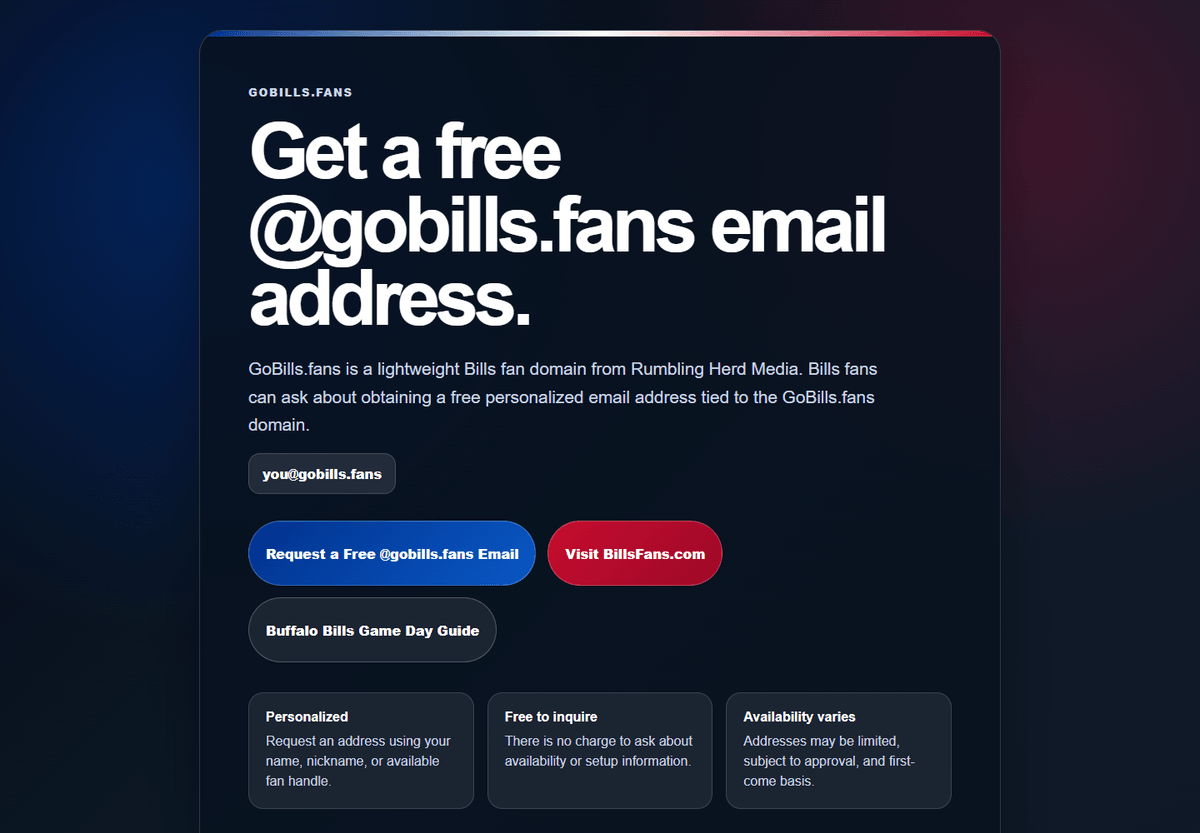
Many fan domains publish news, galleries, or discussion. GoBills.fans uses its name for something smaller and more personal: an invitation to request a free address such as you@gobills.fans. The single-page website presents the offer, explains that names are limited and subject to approval, and provides an email route for availability and setup questions.
The page identifies GoBills.fans as a lightweight project from Rumbling Herd Media and connects it to BillsFans.com. It should not be confused with an email service operated by the Buffalo Bills or the NFL. Within that independent context, the project offers a useful example of how a domain can function as shared community infrastructure rather than only as a publishing address.
Case Snapshot
- Website: gobills.fans
- Category: independent supporter identity and email project
- Primary audience: Buffalo football supporters seeking a personalized fan address
- Main purpose: invite requests for an available @gobills.fans email identity
- Observed features: example address, request-by-email workflow, availability notice, approval notice, and links to related fan media
The Domain Becomes the Product
On most websites, the domain is simply how visitors reach the content. Here, the domain is also the value being offered. The local part before the @ symbol can be a name, nickname, or fan handle, while the shared ending communicates group identity every time the address is displayed.
This makes the proposition easy to understand. A visitor does not need to read a long feature list: the sample address demonstrates the idea. The `.fans` extension is especially visible in email, where it becomes part of a repeated identity rather than a destination someone visits once.
A Manual Request Flow Fits an Early, Limited Service
GoBills.fans asks interested visitors to contact support to check availability and discuss setup. That manual workflow can be appropriate for a small project. It allows the operator to review names, prevent obvious impersonation or abuse, and learn what people expect before investing in account automation.
The page also says names are limited, subject to approval, and handled on a first-come basis. Those constraints are useful because desirable words, player names, staff identities, and short handles can create disputes. A mature allocation policy should go further by identifying reserved terms, prohibited impersonation, inactive-account handling, appeal routes, and whether an address can ever be reclaimed.
One Focused Offer Can Connect a Wider Community
The site links to BillsFans.com and a game-day guide, placing the email project within a broader independent fan-media ecosystem. The email address can act as a memorable entry point, while the related website provides the richer content destination. This division of roles keeps GoBills.fans simple rather than duplicating an entire publication.
For community operators, the model is worth noting. Not every domain needs a large content plan. A short address can support one clear utility and direct visitors to established resources elsewhere. The essential requirement is that the relationship between the services is explicit so users know who operates their address and where to seek support.
Why the .fans Domain Fits
An email identity has to communicate quickly. “Go Bills” is a familiar supporter expression, and `.fans` makes the audience context visible. Together, they form an address that can feel communal without requiring a long explanation.
That clarity also creates responsibility. Recipients may assume that messages from a branded fan address carry community authority. The operator should make independence from the team and league visible on the website, in onboarding, and where appropriate in account policies. Users should also be prohibited from using an address to imply employment, endorsement, ticketing authority, or an official team relationship.
Execution Lessons for Community Email Projects
- Demonstrate the offer with a real format. A sample address explains the service faster than abstract copy.
- Start with controlled allocation. Manual review can help a small operator learn demand and prevent obvious misuse.
- Publish naming rules. Reserved words, trademarks, impersonation, offensive handles, inactivity, and disputes need predictable treatment.
- Make the service model explicit. Users should know whether they receive a mailbox, forwarding, an alias, or another arrangement.
- Plan for continuity. Email identities can become part of account recovery and personal correspondence, so suspension or shutdown cannot be handled casually.
Security, Privacy, and Reliability Boundaries
The public page does not detail the technical delivery model, storage, spam filtering, account recovery, or retention practices. Prospective users should ask before relying on an address for important accounts. A forwarding alias has different privacy and security implications from a hosted mailbox, and neither should be described vaguely once real messages are involved.
The operator needs policies for authentication, abuse reporting, malware and phishing, data access, law-enforcement requests, backups, and account termination. Domain-level controls such as SPF, DKIM, and DMARC can help recipients evaluate messages, but configuration alone does not replace user education and active abuse response. Addresses should never be marketed as permanent unless long-term continuity is genuinely supported.
Users also need to understand the risk of using a community address for password resets or financial, medical, employment, and government services. If the address is suspended, reassigned, or discontinued, access to those external accounts may be affected. A clear acceptable-use policy and export or transition process protect both the community and the individual.
Practical Takeaways
A community email project should define its operational model before accepting requests. Decide whether the service is forwarding or hosted, which provider processes mail, how identities are verified, what names are reserved, how long logs are kept, and what support level is realistic. Publish these answers in plain language, then use a staged invitation process to test demand and workload.
The .fans use cases demonstrate how community-focused names can support tools as well as publications. The .fans identity overview explains why the extension communicates audience belonging, and the registration page provides a route for checking suitable names.
Conclusion
GoBills.fans is a compact example of a domain becoming a shared identity layer. Its sample address, limited availability, and manual request process make the concept immediately understandable. The larger lesson is operational: email creates a deeper trust relationship than a typical fan page. Clear independence, naming rules, privacy, security, abuse handling, and continuity are therefore not background details. They determine whether a memorable address can become a responsible community service.