
FlappyBird.fans is an independent, fan-made browser game built around a familiar one-button challenge: keep a small bird in the air and pass through a sequence of openings. The website removes most of the friction between arrival and play. Visitors can use a mouse, touch input, or the space bar, and the game presents the current score, personal best, pause control, and audio control in the same focused interface.
The project does not claim to be the original game or an authorized continuation. Its footer says it is independent and is not affiliated with or endorsed by the original creator or rights holders. That disclosure matters because both the name and gameplay concept are recognizable. With that boundary stated, the site offers a useful case study in how a small fan project can turn a memorable idea into a transparent, repeatable browser experience.
Case Snapshot
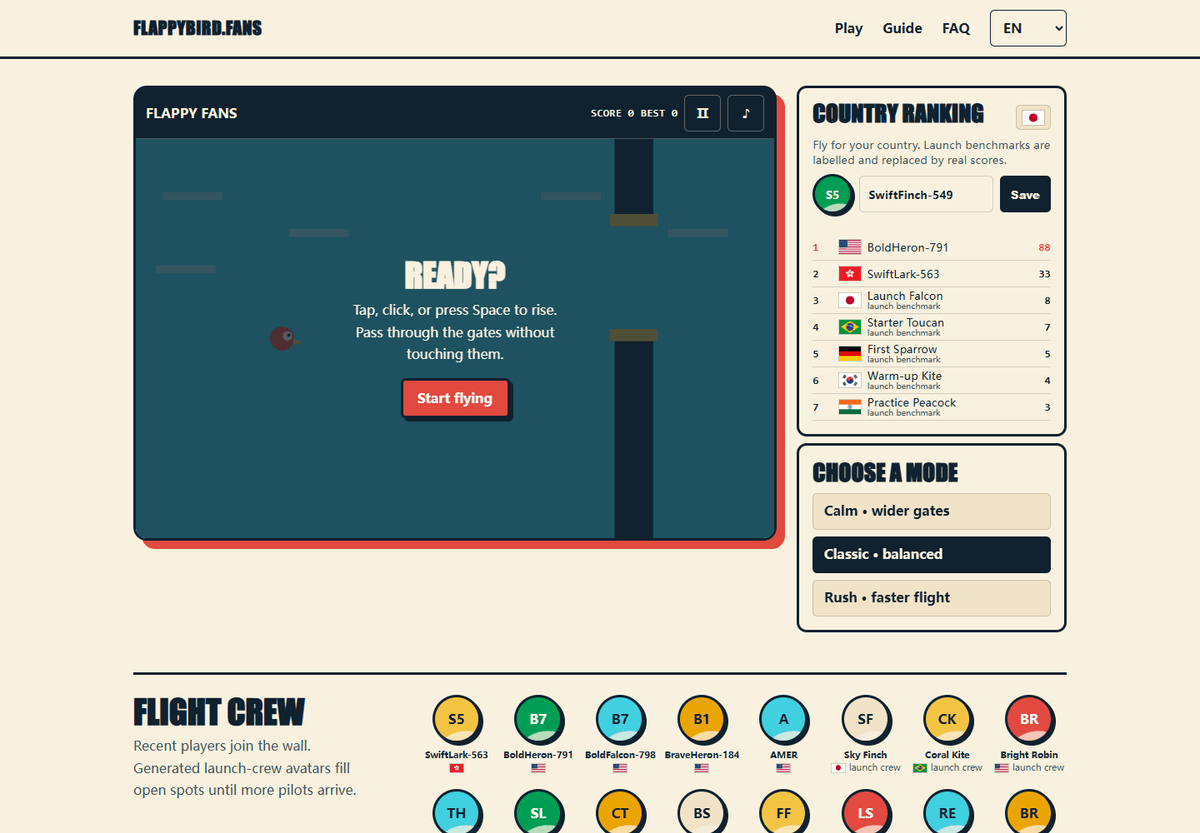
- Website: flappybird.fans
- Category: independent fan-made browser game
- Primary audience: casual players seeking a quick reflex challenge
- Main purpose: instant play with several difficulty modes and score comparison
- Observed features: mouse, touch, and keyboard controls; local best score; three modes; country ranking; game guide; FAQ; and multilingual navigation
The First Action Is the Product
FlappyBird.fans puts the game itself at the center of the homepage. There is no account wall, long tutorial, or download requirement before the first attempt. A short control prompt is enough because the input model is simple. This is an important design choice for any lightweight game: when the core interaction is easy to understand, the page should let visitors discover it by doing.
The surrounding controls support the session without competing with it. Score and best score create immediate feedback. Pause and sound controls respect different playing environments. The website says the personal best is stored on the device, so visitors can retain a modest sense of progress without creating an account. That keeps onboarding light, although players should understand that local progress may not follow them to another browser or device.
Three Modes Create a Natural Difficulty Ladder
The site offers Calm, Classic, and Rush modes. Calm uses wider gaps, Classic presents the balanced experience, and Rush increases the pace. This is a compact way to serve several audiences without changing the fundamental control scheme. A new player can learn timing in a more forgiving setting, while an experienced player can choose a faster challenge.
The separate game guide reinforces that progression. It emphasizes rhythm, watching the next opening, and making small corrections rather than reacting with large movements. These are specific, useful instructions tied to the actual interaction. For community game builders, that is a better pattern than a generic “how to play” page: explain the decisions that improve a player's next attempt.
Competition Works Best When the Data Is Explained
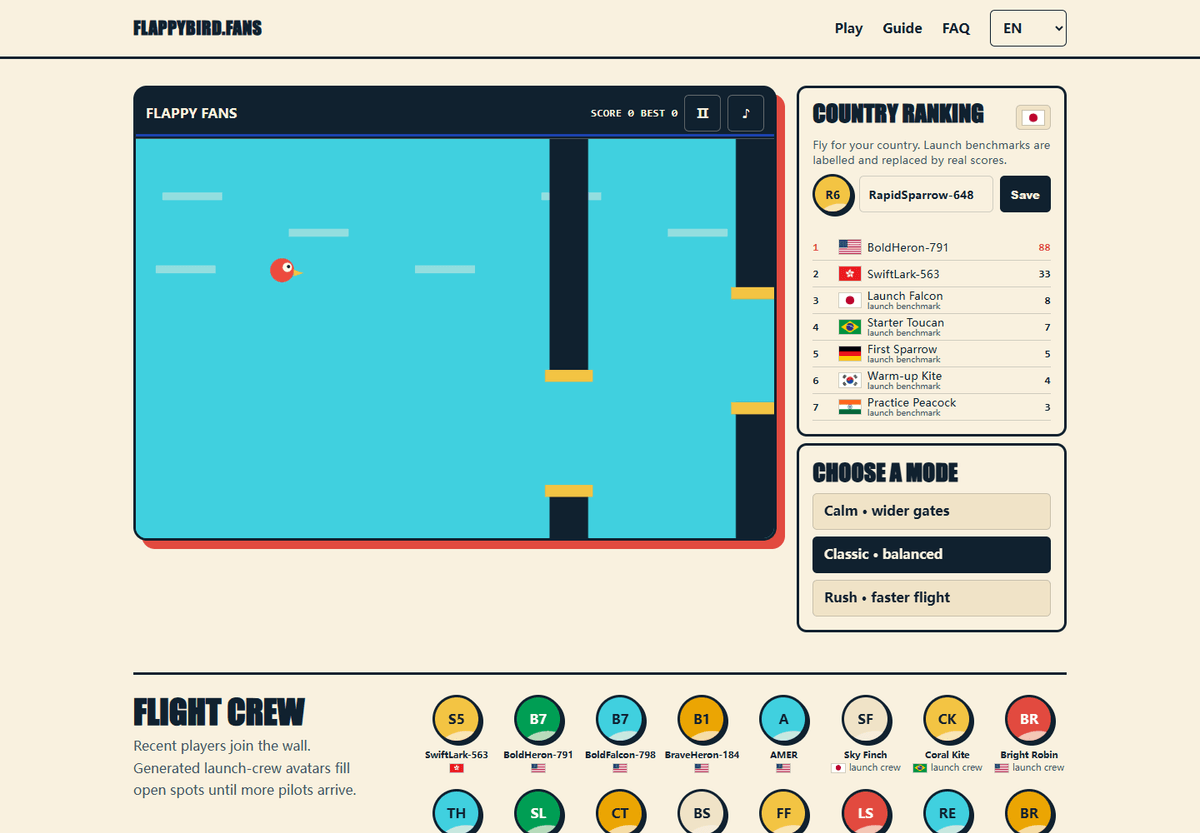
A country ranking gives the game a broader competitive frame. Instead of treating every run as an isolated score, the interface lets players compare performance through a recognizable group identity. That can create a reason to return, particularly when the underlying session is short.
FlappyBird.fans also labels some launch values as benchmark scores and explains that real scores will replace them. The crew wall similarly indicates that generated launch avatars occupy open positions until real players arrive. Those disclosures are valuable. Seed data can prevent an empty interface, but it should never be mistaken for organic participation. Clear labels preserve the difference between a designed starting state and genuine community activity.
Why the .fans Domain Fits
The `.fans` ending frames the project as a destination made around shared enthusiasm rather than as the original publisher's official property. It also matches the site's community elements: rankings, player handles, and a crew wall all extend the experience beyond a single anonymous game session.
That fit depends on visible independence language. A fan-oriented domain does not itself grant permission to use another party's name, characters, artwork, sounds, or game assets. The operator still needs to review trademark and copyright questions, use original or properly licensed materials, and maintain a clear contact route for rights concerns.
Execution Lessons for Small Browser Games
- Shorten the path to play. Put the primary interaction on the first screen and explain only what the visitor needs for the first attempt.
- Offer progression without fragmenting the game. Difficulty modes can reuse one control model while accommodating beginners and experienced players.
- Keep feedback visible. Current score, personal best, pause, and sound controls help a short session feel complete.
- Label artificial starting data. Benchmark scores and generated profiles should be visibly distinct from real participation.
- Explain storage and identity. Players should know what stays on their device, what enters a public ranking, and how handles or country information are used.
Rights, Privacy, and Community Boundaries
The site's independent-project disclaimer is a necessary first step, not the end of the governance work. A recognizable game concept requires careful review of branding and assets. The same caution applies to player-facing data. If a handle, country selection, or score becomes public, the site should explain retention, moderation, correction, and removal processes. It should also prevent abusive names and automated score manipulation.
The multilingual interface broadens accessibility, but every translation should preserve the same rules and disclosures. Privacy, terms, scoring definitions, and independence language should not become weaker in secondary languages. A consistent policy layer is part of the product, especially when a game invites public comparison.
Practical Takeaways
A creator planning a small community game can begin with one satisfying action, one clear success measure, and one reason to try again. Add difficulty levels only when each one serves a distinct player need. If rankings are introduced, define what is measured, how ties and invalid scores are handled, and which data becomes public. Empty states can be designed, but sample information must be identified honestly.
A focused address can help the experience feel memorable. The .fans use cases show how audience projects can take different forms, while the .fans identity overview explains the extension's community-oriented positioning. Creators can explore available names through the registration page.
Conclusion
FlappyBird.fans demonstrates the strength of a compact browser experience: immediate play, understandable controls, visible progress, and enough variation to support repeated attempts. Its most transferable lesson is not the familiar game mechanic but the discipline around it. A lightweight product feels complete when onboarding, difficulty, feedback, data disclosure, and independence boundaries all receive attention.