
Personal-development services are difficult to organize because visitors arrive with different levels of clarity. One person wants a low-commitment self-assessment, another wants a course, and another is considering sustained one-to-one support. Ferry.fans brings these routes together under the Chinese brand “Ideal Ferry”.
The website describes the ferry as an entry point for people who want to understand themselves, face themselves, and move toward a life of their own choosing. Its public catalog includes a Jungian cognitive-functions assessment, a course about suitable work, one-to-one consulting and coaching, a talent-development camp, and an INTJ-focused course. The case is useful for its service architecture, not as proof that the underlying personality frameworks produce scientific or clinical outcomes.
Case Snapshot

- Website: ferry.fans
- Brand: Ideal Ferry
- Category: Chinese-language personal-development services
- Public offers: self-assessment, online courses, one-to-one consulting, coaching, and a training camp
- Public service pages: account login, user agreement, privacy policy, product terms, and support contact
The Ferry Metaphor Organizes the Brand
The site explains that its name draws on the ferry in Hermann Hesse's Siddhartha. The image works as a service metaphor: visitors are not promised an instant destination; they are offered an entry point and accompaniment while moving from reflection toward action.
That idea appears consistently in the homepage language, quiet visual design, product descriptions, and the phrase about aligning ideals with daily life. A strong service brand benefits from this kind of coherence. The metaphor is meaningful only because the product catalog also presents a sequence of possible next steps.
A Service Ladder Supports Different Commitments
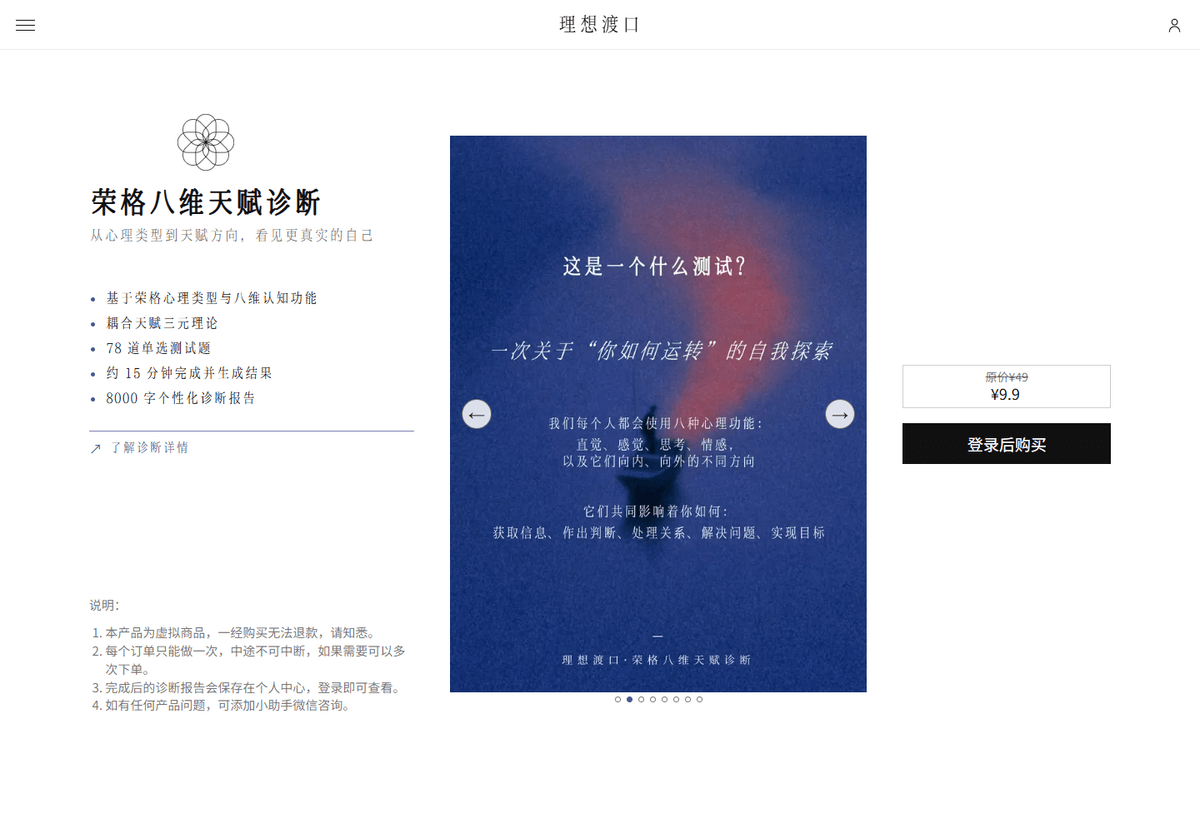
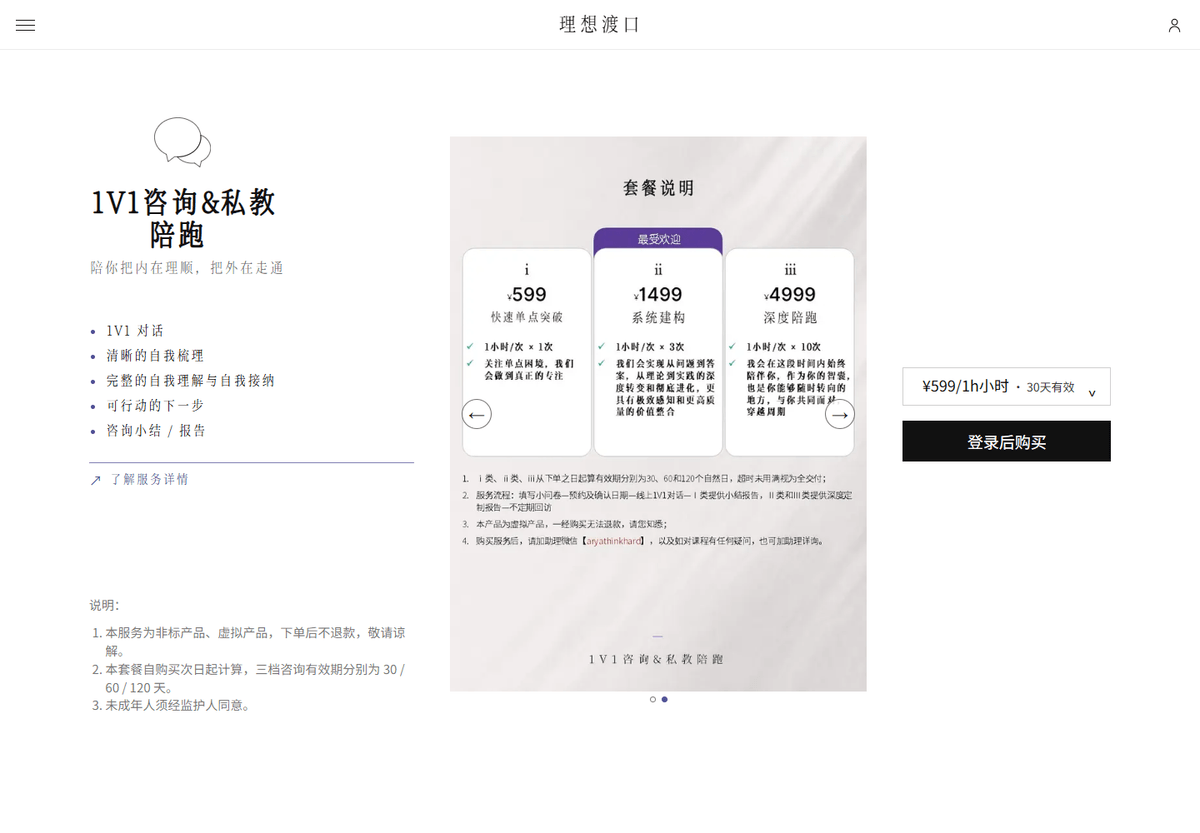
The assessment is a relatively bounded digital product. Its page describes a fixed set of questions, an estimated completion time, and a personalized report. Courses provide more structured learning. The training camp adds an extended format and feedback. One-to-one consulting becomes the highest-touch option, with packages that vary by session count and validity period.
This creates a service ladder without forcing every visitor into the same purchase. Someone can begin with a self-guided activity, then decide whether education, group practice, or individual support is appropriate. Each step should explain what it includes, what it does not include, and whether completing one product is required before another.
Product Pages Combine Promise and Terms
The reviewed assessment page displayed its method, question count, estimated time, report format, price, login requirement, and virtual-product refund notice. The consulting page listed intended outcomes, package duration, pricing choices, a post-session summary or report, a no-refund statement, and a guardian-consent requirement for minors.
Putting operational details on the product page helps visitors evaluate the purchase before checkout. For non-standard or coaching services, the page should also clarify scheduling, rescheduling, missed sessions, provider qualifications, confidentiality, record retention, emergency boundaries, complaints, and what happens when the service is not a suitable fit.
Community Extends the Product Relationship
The homepage describes diagnosis, courses, consulting, and community as ways the brand accompanies visitors. Community can add accountability and peer learning, but it changes the risk profile. Participants may disclose personal experiences, career uncertainty, or emotional concerns that require careful moderation and privacy controls.
A responsible community should define who can join, what may be shared, whether sessions are recorded, how private messages are handled, and how harmful advice is addressed. Staff should know when to refer a participant to qualified medical, psychological, legal, or financial support.
Why the .fans Domain Fits
“Ferry” carries the project's central metaphor, while `.fans` gives the address a community-oriented ending. The combination is less clinical than a formal assessment brand and broad enough to support courses, consulting, and shared learning under one identity.
This demonstrates how a community-focused domain can serve a values-led service brand. The extension does not validate a methodology, but it can make the relationship between the brand and its returning audience easier to remember.
Five Lessons for Personal-Development Brands
- Use one clear organizing idea. A consistent metaphor can connect several products without making them feel unrelated.
- Offer different levels of commitment. Self-guided, course, group, and individual formats serve different needs.
- Put terms on the product page. Duration, deliverables, price, refund status, and eligibility should appear before checkout.
- Define professional boundaries. Self-exploration and coaching should not be presented as clinical diagnosis or guaranteed career guidance.
- Design community safeguards early. Privacy, moderation, minors, referrals, and crisis boundaries need explicit procedures.
Assessment and Advice Boundaries
Jungian or MBTI-style tools can give users a vocabulary for reflection, but they should not be treated as medical diagnosis, psychological evaluation, scientific proof of talent, or a deterministic answer to career decisions. Results depend on the instrument, self-reporting, interpretation, context, and the limits of the framework.
Visitors should understand the qualifications of anyone providing consulting, the evidence behind claims, and the difference between education, coaching, counseling, and healthcare. Prices, promotions, refund language, and service availability are also time-sensitive; the current product page and agreement should be reviewed before purchase.
Practical Takeaways
A personal-development project can map every offer by audience need, commitment, delivery format, duration, provider, expected output, evidence level, price, refund rule, privacy requirement, and escalation boundary. This makes it easier to show a suitable next step without promising that one path works for everyone.
For the naming layer, browse .fans use cases, consult the .fans FAQ, and check a community name through the registration page. The address should reinforce the brand idea while the product pages carry the detailed responsibilities.
Conclusion
Ferry.fans shows how a personal-development brand can turn one metaphor into a structured journey across assessment, learning, group practice, and individual support. Its strongest execution lesson is the service ladder: visitors can see several levels of participation within one coherent home. The `.fans` ending supports a sense of continuing community, while clear evidence, consumer terms, privacy, and professional boundaries are what make that journey responsible.