
A fan community can begin with enthusiasm, but running it requires repeatable work: onboarding, publishing, moderation, subscriber support, tooling, budgets, disclosures, and escalation. Codify.fans approaches those questions as an AI-native domain agent paired with public operational programs.
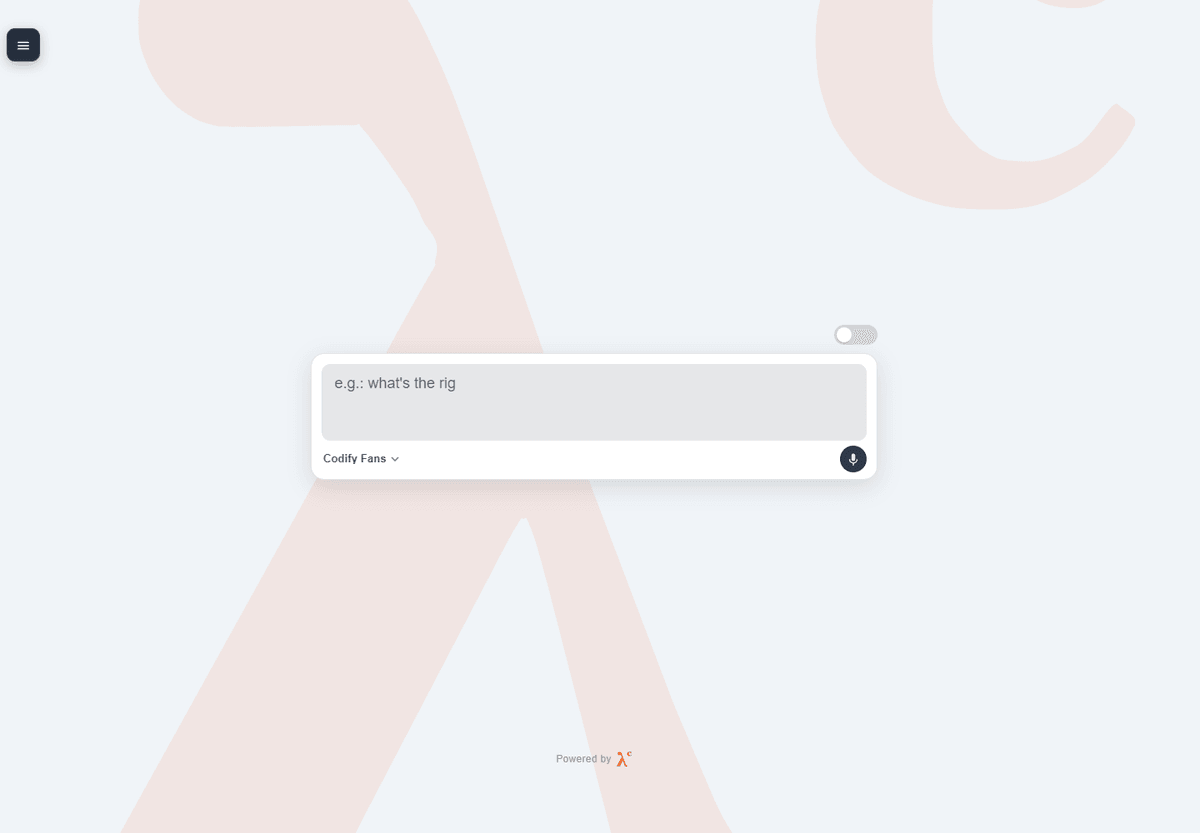
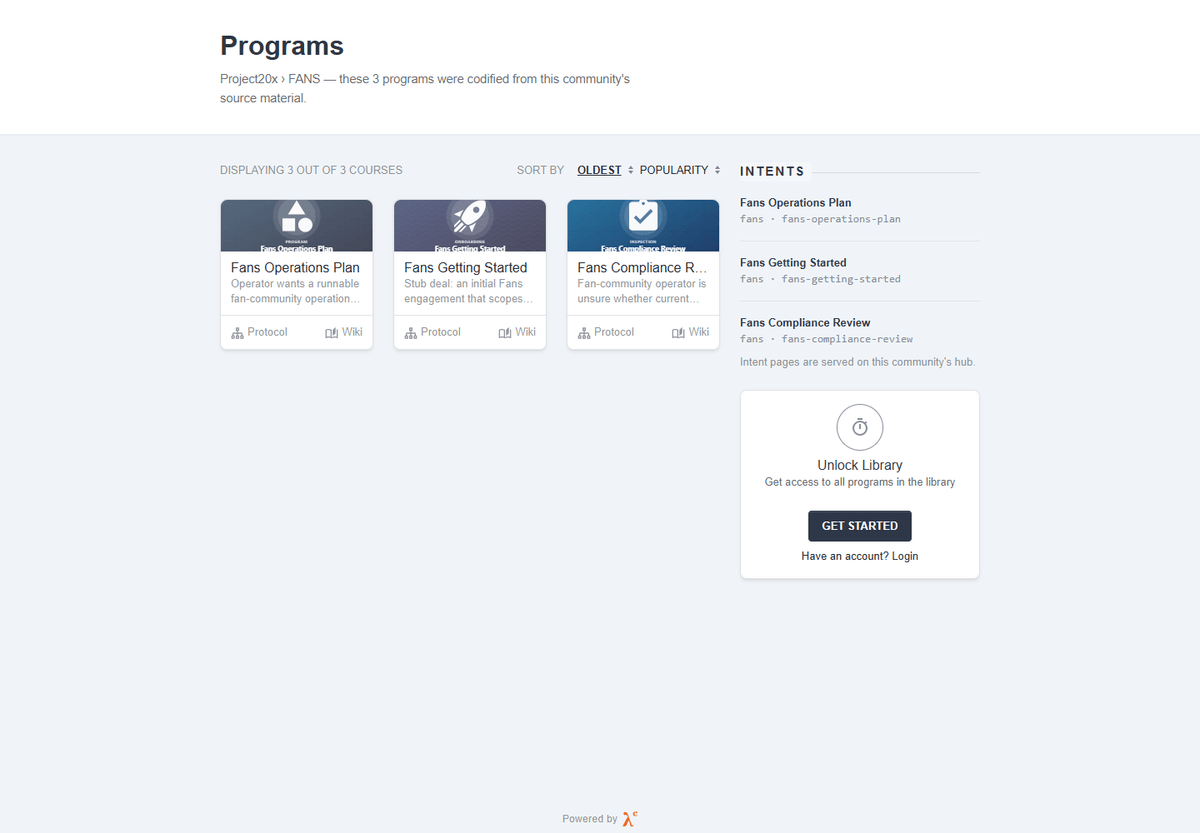
The homepage is intentionally sparse. It centers a prompt field labeled Codify Fans. The public program library supplies the visible structure behind that interface, presenting three programs for getting started, building an operations plan, and reviewing compliance. This makes the case useful even without testing private or generated answers: the public pages show how broad community questions can be converted into explicit workflows.
Case Snapshot
- Website: codify.fans
- Category: AI-native domain agent and operational program library
- Primary audience: fan-community and creator-subscriber operators
- Public programs: Fans Operations Plan, Fans Getting Started, and Fans Compliance Review
- Observed structure: prompt interface, programs, protocols, modules, commits, wiki links, login, and contact
A Prompt Is the Entrance, Not the Whole Product
The homepage invites a natural-language question. That is a familiar pattern for AI tools, but Codify's more distinctive element is the connection to named programs and source material. The program page says that the three programs were codified from community material and exposes links to protocols and wiki entries.
This reduces a common weakness of chat-only products. A useful answer should not disappear as an isolated conversation. It should connect to a stable process, identify required inputs, show who reviews each stage, and leave an artifact that a team can revisit. The public program pages suggest that operational knowledge is intended to be structured rather than left as free-form advice.
The Operations Plan Shows a Reviewable Sequence
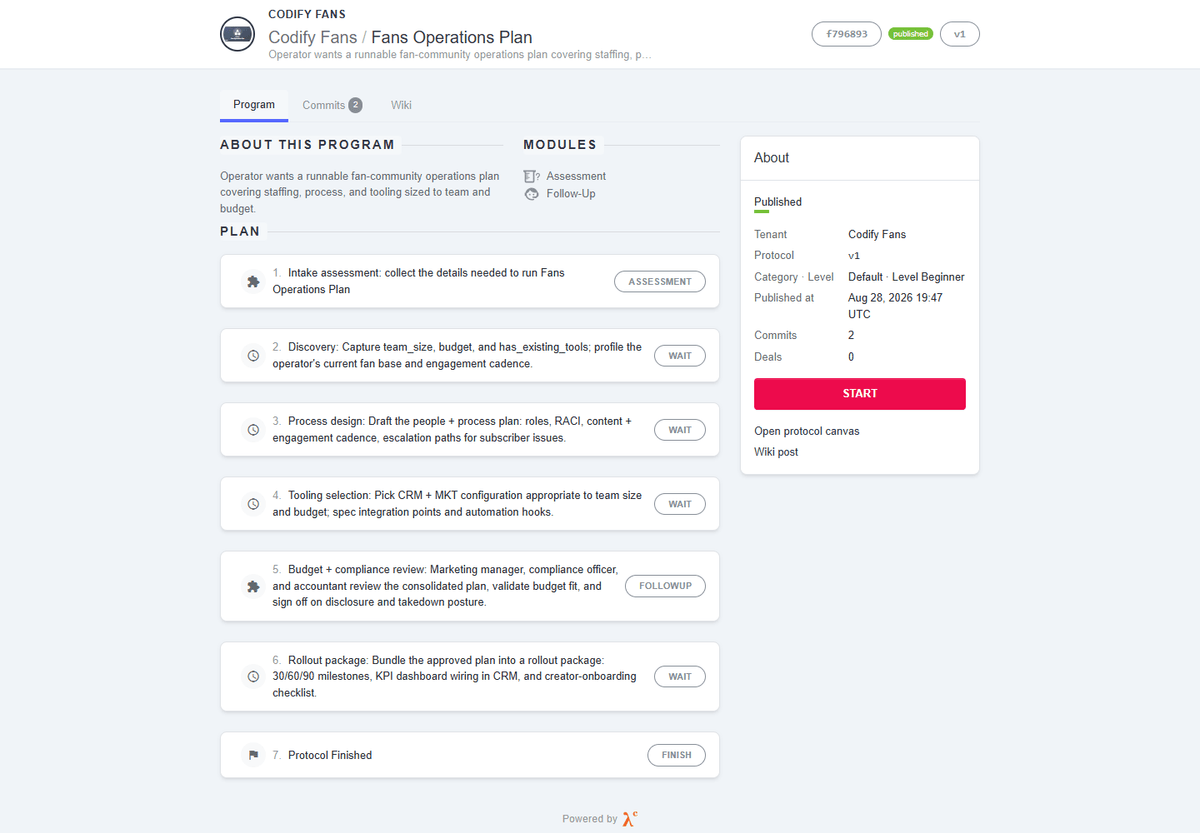
The Fans Operations Plan page lays out a sequence beginning with intake and discovery. It asks for details such as team size, budget, existing tools, current fan base, and engagement cadence. It then moves through process design, tooling selection, budget and compliance review, and a rollout package.
The process-design stage names roles, responsibilities, content cadence, and escalation paths. The tooling stage addresses CRM and marketing configuration. The review stage calls for marketing, compliance, and accounting perspectives. The final package refers to milestones, dashboard setup, and creator onboarding.
Whether a generated plan is good depends on the quality of its sources, prompts, constraints, and human review. Still, the visible sequence offers a useful design principle: break a broad request into stages with named inputs, outputs, and decision owners.
Different Questions Deserve Different Programs
The Getting Started program is framed as an initial engagement that scopes goals, timing, and a first concrete step. The Compliance Review program addresses creator-subscriber agreements, disclosures, moderation procedures, and applicable rules. The Operations Plan goes deeper into ongoing execution.
Separating these programs prevents one oversized assistant from pretending every question is the same. A new community needs orientation. An established community may need process improvement. A team facing policy uncertainty needs qualified review. Intent-based routes can help an AI product choose a suitable workflow before it produces an answer.
Why the .fans Domain Fits
The domain names the subject area directly. “Codify” describes turning informal knowledge into an explicit form, and `.fans` identifies the community context. The result reads as a compact product statement: codify the work involved in serving fans.
This illustrates how a purpose-led .fans identity can support a tool for operators as well as a destination for audiences. The extension frames the domain of knowledge, while program names handle the specific task.
Four Lessons for AI Workflow Products
- Turn recurring requests into named programs. Stable workflows are easier to inspect and improve than one-off chat answers.
- Expose the required inputs. Team size, budget, tools, goals, and existing practices materially change an operations plan.
- Insert human review where consequences rise. Compliance, accounting, contracts, and moderation should not be delegated blindly.
- Preserve versions and supporting material. Commits, protocols, and wiki pages can help teams understand how a program changed.
AI and Compliance Boundaries
The presence of a Compliance Review program does not make an AI output legal advice or proof of compliance. Laws, platform rules, consumer duties, labor arrangements, taxes, disclosures, privacy requirements, and content risks vary by jurisdiction and business model. Qualified professionals must review decisions that carry legal or financial consequences.
Teams should also ask what source material the agent uses, how recent it is, whether confidential inputs are stored, who can access generated plans, and how errors are corrected. The public interface was reviewed for structure; this case study did not evaluate answer accuracy, security, privacy controls, or operational outcomes.
Practical Takeaways
A community operator can apply the underlying method without beginning with AI. Choose one repeated task, document the input questions, break the work into stages, assign an owner to each decision, define the output, and record a review date. Once the process is understandable to humans, an agent can help collect information or draft materials without becoming the unaccountable decision maker.
Teams exploring a dedicated operational hub can review .fans use cases, consult the .fans FAQ, and check a name through the registration page. The best address should communicate the community context while leaving each workflow clearly named.
Conclusion
Codify.fans shows a practical direction for community-focused AI: connect an open-ended question to a structured, versioned program. Its operations-plan page makes staffing, process, tools, review, and rollout visible as separate stages. The `.fans` domain gives those programs a defined subject area. The enduring lesson is not that AI can run a fan community alone, but that explicit workflows make both human and machine assistance easier to evaluate.