
A complete sports schedule answers one question: what is happening? It does not necessarily answer the more practical question a casual viewer has on a busy day: which game is worth my time? Casual.fans is designed around that choice.
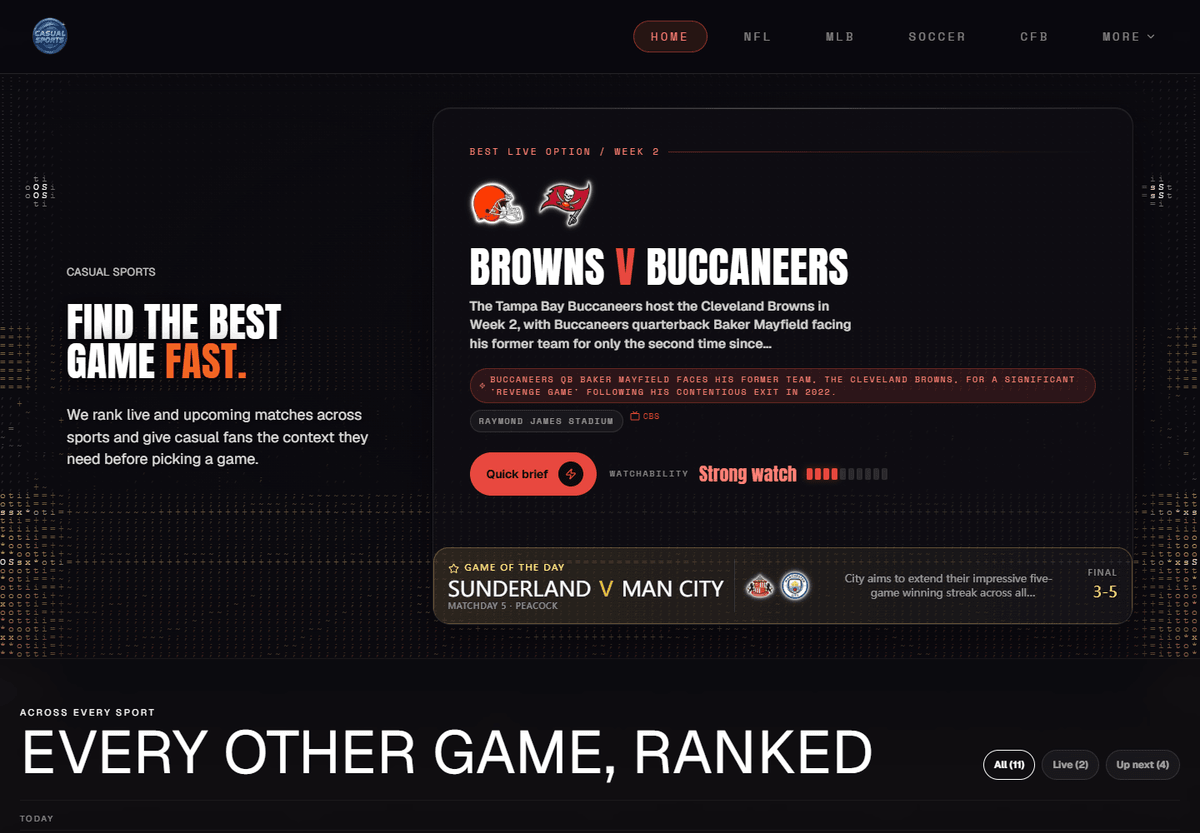
The live website brings NFL, MLB, soccer, and college-football fixtures into one interface. It highlights a best live option, identifies a game of the day, ranks other choices, and adds a short explanation for each recommendation. The product is less like a traditional scores archive and more like an editorial discovery layer placed over changing sports data.
Case Snapshot
- Website: casual.fans
- Category: multi-sport game discovery and ranking
- Primary audience: viewers who want help choosing what to watch
- Sports observed: NFL, MLB, soccer, and college football
- Public features: live and upcoming filters, rankings, quick briefs, watchability labels, results, broadcast fields, and update timestamps
The Product Begins with a Decision
Many sports sites compete on depth. They publish every score, player statistic, roster move, and article. Casual Sports narrows the first screen to a decision: “Find the best game fast.” That framing gives the interface a clear job and allows the site to prioritize information differently.
A featured card combines matchup, status, a short storyline, venue or viewing information, and a watchability judgment. Below it, other games are ordered rather than merely listed. Visitors can move among all games, live games, and upcoming games. The ranking is the editorial product; scores and schedules are the changing inputs.
Context Makes a Ranking Useful
A label such as “strong watch” has limited value by itself. Casual Sports supports its labels with compact reasons: a rivalry, a streak, a postseason implication, a notable return, or another storyline visible on the page. That explanation helps a visitor decide whether the site's priorities match their own.
This is an important design lesson for recommendation products. A ranking should expose enough reasoning to be challenged. The visitor does not need a long essay before kickoff, but they do need more than a mysterious score. A short brief, a few relevant facts, and an explicit editorial label can make the recommendation understandable without turning the screen into a news feed.
Separate Sport Pages Preserve Familiarity
The homepage mixes sports, while dedicated NFL, MLB, soccer, and college-football pages use the same basic visual language. This gives visitors two routes. Someone open to any event can start with the cross-sport board. Someone already committed to a league can skip directly to that sport.
Shared components also make the experience easier to learn. Status, matchup, storyline, watchability, timing, and viewing information appear in consistent positions. The subject changes, but the decision pattern remains stable. A fan product serving several communities can use this approach to avoid building unrelated microsites for every category.
Freshness Is Part of the Interface
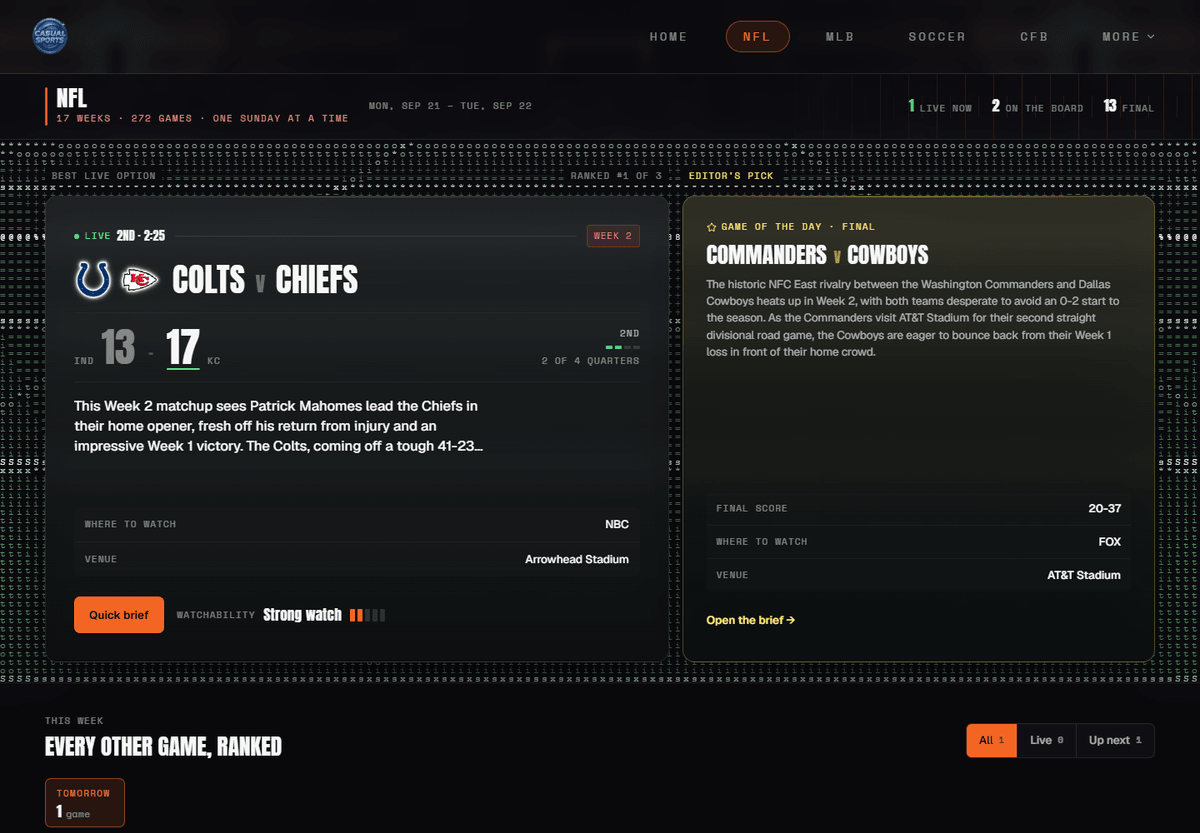
Sports information can become wrong in minutes. During review, the site showed update timestamps and stated that rankings refresh frequently while games are live. It also warned that schedules and data may change. Those details are not footer decoration; they help the reader interpret the page.
Any similar service should treat source timing, postponements, time zones, score corrections, and broadcast availability as core product requirements. A viewing channel can differ by country or subscription. A “live” label can become stale after a failed data feed. Clear timestamps and a correction path matter as much as visual polish.
Why the .fans Domain Fits
The address describes both the audience and the level of expertise the product welcomes. “Casual” lowers the barrier for visitors who enjoy sports without following every league closely. `.fans` makes that audience relationship explicit. Together, the words promise a guide for fans, not a professional scouting database.
This is a useful example of how a fan-focused domain identity can state the intended user before the homepage loads. The domain does not verify data quality or league affiliation, but it does make the service category memorable.
Four Lessons for Sports Discovery Products
- Choose one high-value question. “What should I watch?” is more focused than trying to become a complete sports portal.
- Explain the ranking. A short storyline lets users judge the recommendation rather than accept a black-box score.
- Offer broad and narrow routes. A cross-sport board supports discovery, while sport pages serve existing preferences.
- Show data age. Update times, schedule warnings, and feedback access reduce false confidence in changing information.
Rights and Accuracy Boundaries
Team names, league names, logos, schedules, broadcast names, and venue details can involve trademark, licensing, database, and territorial issues. The site reviewed here should not be assumed to be affiliated with any league, club, team, or broadcaster unless an authoritative source confirms that relationship.
Recommendations are also editorial judgments, not objective measures. A transparent service should explain its criteria, distinguish sourced facts from commentary, correct errors quickly, and avoid implying that a watchability label predicts a result. Viewers should confirm schedules and access through the relevant rights holder or broadcaster.
Practical Takeaways
A team building a similar destination can begin with a compact data model: sport, competition, teams, start time, status, location, viewing availability, source timestamp, storyline, ranking reason, and editorial label. The interface should make the source time visible and degrade gracefully when a feed is delayed.
For naming and structure, explore other .fans use cases, review the .fans FAQ, and check a suitable address through the registration page. The strongest domain should reinforce a specific user decision rather than merely repeat a broad category.
Conclusion
Casual.fans shows how a sports product can create value by reducing choice. Its rankings, quick briefs, and consistent sport pages help visitors move from a crowded schedule to one understandable recommendation. The `.fans` ending makes the intended audience clear, while the word “casual” sets a welcoming level of detail. The lasting lesson is simple: when data is abundant, thoughtful prioritization can be the product.